Sim vs. Arcade Racing Games: What’s the Difference?
Arcade, sim-cade and simulation racing games explained: physics, tires, damage, assists and learning curves, with examples from Mario Kart to iRacing.
Every racing game puts you behind a wheel, but the experience of driving a kart through a rainbow-colored track has very little in common with nursing a GT3 car through a wet night stint. Players and reviewers usually sort racing games into three broad groups: arcade, sim-cade and simulation. The labels are loose and sometimes argued over, yet they are genuinely useful when you are trying to work out whether a game will suit you.
This guide explains what actually differs between the three styles, where the best-known series sit on the spectrum, and how to decide which one to start with. It is about games and how they feel to play, not about real-world motorsport.
Think of It as a Spectrum, Not Three Boxes
The most important idea is that “arcade” and “sim” are two ends of a line rather than separate categories. A game’s position depends on several design choices layered together: how the physics model treats grip and weight, how much the game helps you, how punishing mistakes are, and how much it expects you to understand about cars.
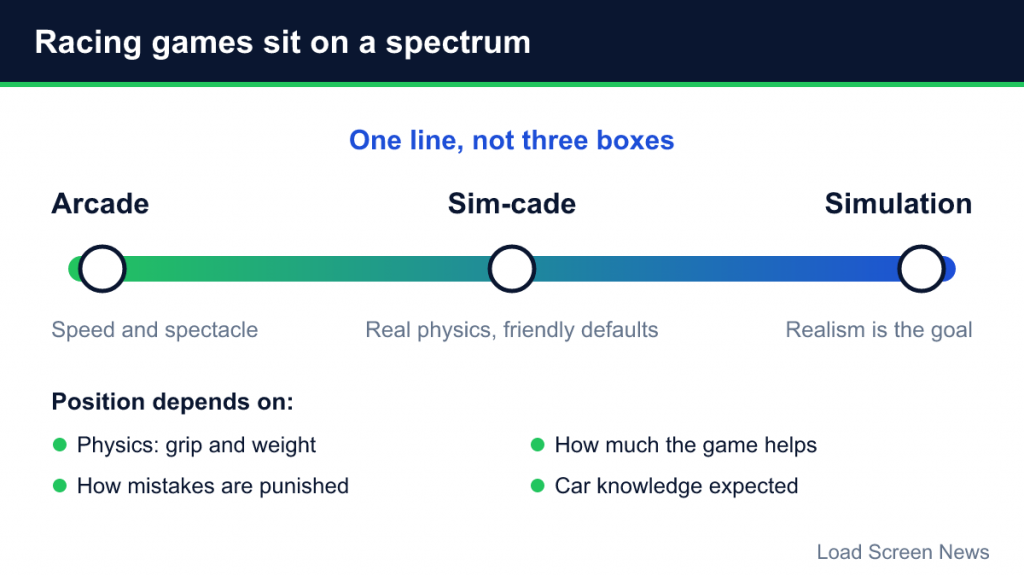
Many popular games also move along that line depending on settings. A simulation title with every assist switched on can feel forgiving, and some arcade-leaning games become noticeably more demanding with assists off. When people say a game is “sim-cade,” they usually mean its underlying physics are grounded in reality but its defaults, structure and tolerance for mistakes are designed for a wide audience.
Arcade Racing: Speed, Spectacle and Instant Fun
Arcade racers prioritize immediate enjoyment. You can pick up a controller and be competitive within minutes. Typical traits include:
- Exaggerated grip and forgiving handling. Cars stick to the road at speeds that would be impossible in reality, and drifting is often a deliberate, easy-to-trigger technique rather than a loss of control.
- Boost and reward systems. Drift boosts, nitrous meters and slipstream bonuses reward stylish driving rather than precise lap times.
- Light or cosmetic damage. Crashing rarely ends a race; you are reset onto the track quickly.
- Rubber-banding and catch-up mechanics. AI opponents often speed up or slow down to keep races close.
- Short learning curve. The fun is front-loaded; mastery is about routes, timing and item use more than car control.
Kart racers are the purest example. Mario Kart World, released on June 5, 2025 as a launch title for Nintendo Switch 2, supports up to 24 racers and adds a free-roam world plus a Knockout Tour mode in which the last racers are eliminated at checkpoints along one long route. Physics barely matter there; items, shortcuts and drift boosts decide races. The Need for Speed series sits in arcade territory too, with police chases, nitrous and a focus on style and car culture.
Sim-Cade: The Middle Ground
Sim-cade games try to make realistic-feeling cars accessible. The physics models account for weight transfer, tire grip and different drivetrains, but generous default assists and forgiving recovery tools keep the game approachable. This is the most popular part of the spectrum on consoles.
Forza Horizon
Playground Games’ open-world festival series is the best-known sim-cade game. Its cars feel distinct from one another, and tuning matters, yet the structure is built around freedom: open roads, off-road routes, events everywhere and a rewind button that undoes mistakes. Forza Horizon 6, set in a fictionalized Japan, launched on PC and Xbox Series X|S on May 19, 2026, with a PlayStation 5 version scheduled for January 2027, as of October 2026.
Gran Turismo 7
Polyphony Digital’s series is often called “the real driving simulator,” and its physics sit closer to the sim end than Horizon’s. With assists such as traction control, ABS and countersteering assistance switched on, though, it is very approachable on a controller. Gran Turismo 7, released on March 4, 2022 for PlayStation 4 and 5, combines a structured single-player campaign with competitive online racing.
The official F1 games and Forza Motorsport
Codemasters’ F1 games and Turn 10’s Forza Motorsport are circuit racers with serious physics and setup options, yet both ship with assists, racing lines and difficulty settings that let beginners finish races. They are frequently described as sim-cade on default settings and much closer to simulation once assists are off.
Simulation: Realism as the Goal
Simulation racing games aim to reproduce how a real car behaves as faithfully as possible. That changes almost everything about the experience:
- Tire modeling considers temperature, pressure and wear. Cold tires have less grip; overdriven tires overheat and slide.
- Weight transfer is central. Braking shifts load to the front tires, accelerating shifts it to the rear, and abrupt inputs upset the car.
- Damage and mechanical failures can end your race, and contact has consequences.
- Racing rules such as penalties, flags and pit procedures are enforced.
- Setups are deep, covering suspension, aerodynamics, gearing and differentials.
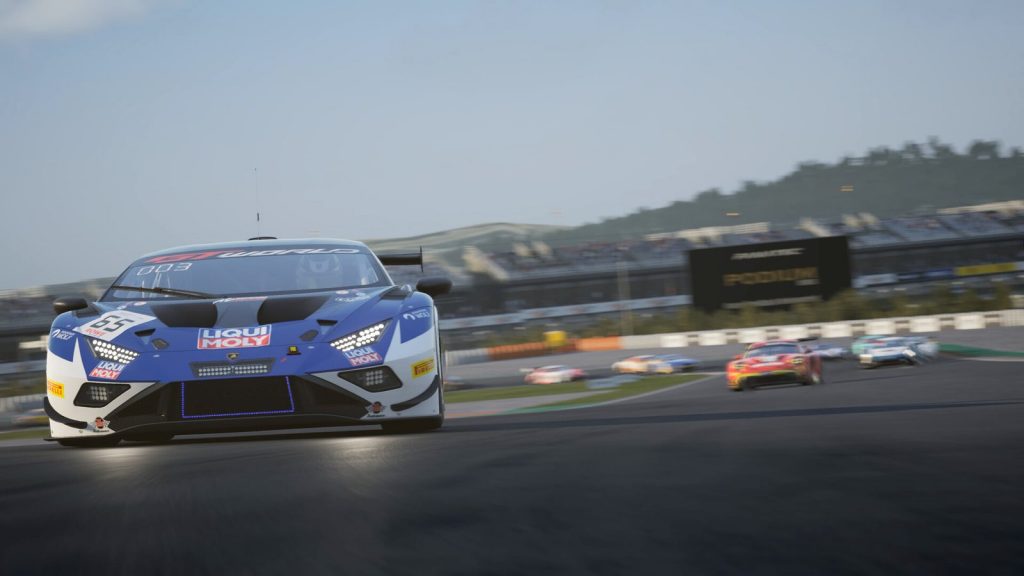
Assetto Corsa Competizione, developed by Kunos Simulazioni, is a good example of a focused sim. It is an officially licensed simulation of GT World Challenge Europe and centers on GT3 cars. It released on PC in May 2019 and reached consoles, first on PS4 and Xbox One in June 2020 and later on PS5 and Xbox Series X|S in February 2022.
iRacing, launched in 2008 for Windows, sits at the far end of the spectrum. It is subscription-based, uses laser-scanned cars and tracks, and organizes online racing through a license system with letter grades and a Safety Rating that rewards clean driving. Its structure is closer to a racing club than a traditional game.
Comparing the Styles Side by Side
| Aspect | Arcade | Sim-cade | Simulation |
|---|---|---|---|
| Physics | Exaggerated grip, easy drifting | Realistic basis, forgiving limits | Detailed tires, weight transfer, aero |
| Assists | Built in, often not adjustable | Many, adjustable | Few by default, often fully off |
| Damage | Cosmetic or none | Cosmetic to moderate | Can end your race |
| Rewind/reset | Instant resets | Rewind common offline | Rare or not available |
| Best input | Controller | Controller or wheel | Wheel and pedals strongly preferred |
| Learning curve | Minutes | Hours to weeks | Weeks to months |
| Examples | Mario Kart, Need for Speed | Forza Horizon, Gran Turismo, F1 games | Assetto Corsa Competizione, iRacing |
Assists: The Slider That Moves You Along the Spectrum
Driving assists are the main reason the categories blur. Anti-lock brakes stop wheels from locking under heavy braking. Traction control limits wheelspin on corner exit. Stability management catches slides before they become spins. Braking assist and steering assist can partly drive for you, and an on-screen racing line shows where to brake and turn.
In a sim-cade game, these assists are what make it accessible. Turn them all off and many sim-cade titles become challenging, demanding precise throttle and brake control. In a hardcore sim, assists are limited to what the real car would have; a GT3 car in Assetto Corsa Competizione has adjustable traction control and ABS because the real cars do, but you will not find a magic steering helper. Arcade games, in contrast, simply build the help into the physics.
Controllers, Wheels and the Learning Curve
Arcade and sim-cade games are designed with a controller in mind and play excellently on one. Gran Turismo 7 on PS5 uses the DualSense’s haptics and adaptive triggers to communicate braking and grip, which helps controller players feel what the car is doing.
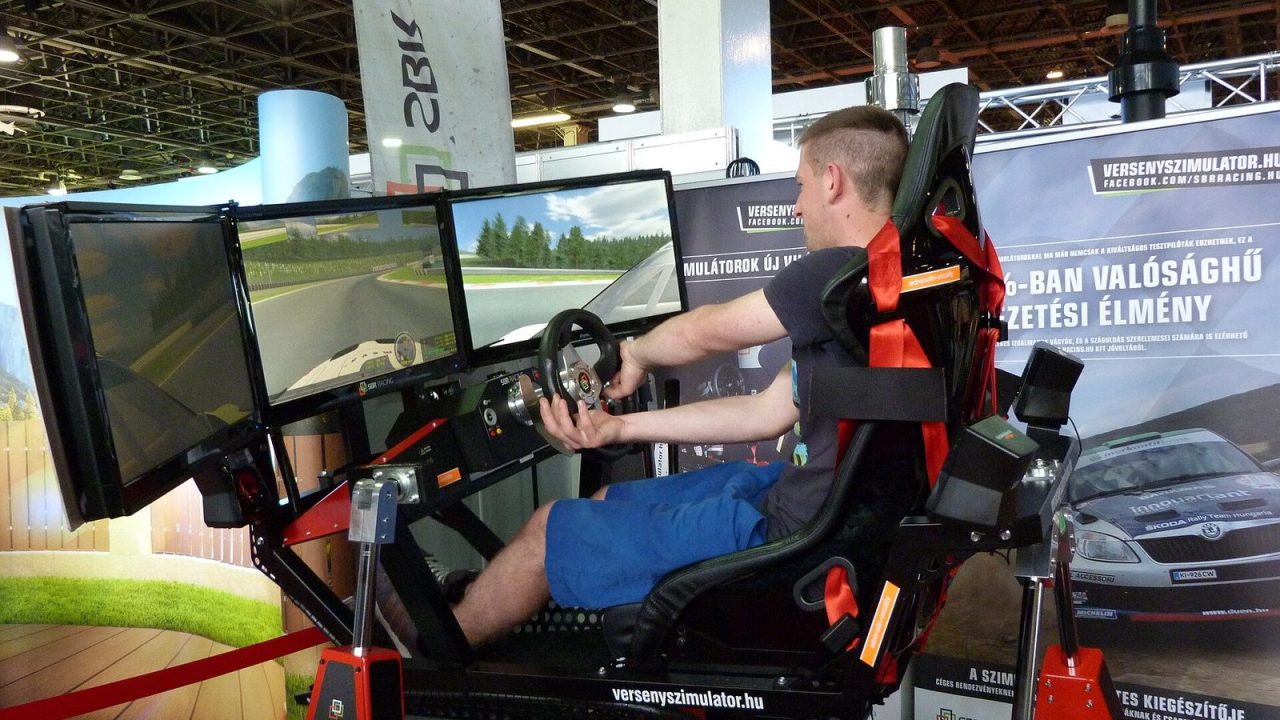
Simulation games can be played on a controller, but the experience is much more demanding, because tiny thumbstick movements translate into large steering inputs and the triggers offer limited precision. Most dedicated sim players use a wheel and pedals. If you are curious about sims, it is reasonable to try one on a controller first to see whether you enjoy the style before considering extra hardware.
Which Style Suits You?
Choose arcade if…
- You want fun in short sessions, couch multiplayer or racing with family.
- You care more about spectacle, items, chases or style than lap times.
Choose sim-cade if…
- You like real cars and want them to feel distinct, but also want freedom and forgiveness.
- You want to grow gradually by switching assists off over time.
- You play mainly on a controller.
Choose simulation if…
- You enjoy practicing the same corner until you find another tenth of a second.
- You want structured online racing with rules, penalties and ratings.
- You are willing to accept a steep learning curve and, ideally, a wheel.
Common Misconceptions
“Arcade games are for kids.” Top-level kart racing and arcade time trials require precise technique and track knowledge. The skill is simply different.
“Sims are always better.” Realism is a design goal, not a quality score. A simulation that frustrates you is a worse game for you than an arcade racer you love.
“Turning off assists always makes you faster.” Not straight away. Assists trade some speed for safety, but switching them off before you can control the car usually costs more time than it saves. Remove them one at a time.
“Sim-cade is just a watered-down sim.” Games like Gran Turismo 7 and Forza Motorsport model a great deal of real behavior. Their accessibility comes from settings and structure as much as from physics.
A Simple Path for Newcomers
If you are not sure where you belong, start in the middle. A sim-cade game lets you experience realistic car behavior with a safety net, and you can move toward either end from there. Spend time learning braking points and corner exits, then try removing one assist at a time. If you find yourself wanting more realism, a dedicated sim is the logical next step. If you find yourself wanting more chaos, an arcade or kart racer will be waiting.
Whatever you choose, the core skills transfer surprisingly well: looking ahead, braking in a straight line, and being patient on corner exit are useful in every racing game ever made.