Career Modes in Sports Games Explained: Play as a Player or Manager
How career modes work in EA Sports FC, NBA 2K, Madden, MLB The Show, NHL and College Football: created players, progression, story and what sets each apart.

Career modes answer a simple fantasy: what if you were the one on the field? Instead of controlling a whole team, you create a single player, or step into a manager’s shoes, and follow that one person through seasons of matches, decisions and milestones. Nearly every major sports series has one, and while they share a basic shape, each takes a distinctive approach.
This guide compares the career modes in the major series as of October 2026, explains the common systems, and helps you decide which one fits your play style. If you are new to sports games in general, start with our beginner’s guide to the major series.
What Career Modes Have in Common
Whether you play football, basketball or baseball, most player-career modes are built from the same four pieces:
- Player creation. You choose a position and appearance, and often a physical profile or archetype that shapes your strengths.
- Progression. Your ratings improve through playing well, training, completing objectives or spending earned points.
- A path through the sport. Many modes start before the pros, with junior, high school, college or draft stages.
- Story and presentation. Cutscenes, conversations, social media feeds or relationships with coaches and teammates add narrative.
A key difference from other modes is that you typically control only your player during matches. In football, that means positioning off the ball; in baseball, it means waiting for your at-bat or a ball hit to your position. Some players love this focus; others find it slow. Most career modes let you simulate to your next involvement or play the whole game.
EA Sports FC: Player Career and Manager Career
EA’s football series offers two careers side by side.
Player Career
Create a footballer or take control of a real player and work toward becoming a starter, earning a move or captaining your nation. EA Sports FC 26 introduced Player Career Archetypes, letting you choose a path or playing style that shapes how your player develops. EA Sports FC 27 adds Rivalries, where you compete against teammates for a starting place. Player growth depends on match ratings, training and objectives set by your manager.
Manager Career
Run a club: transfers, contracts, scouting, youth development, tactics and board expectations. In FC 27, the transfer market has been rebuilt and Dynamic OVR means player ratings now change during the season depending on form, morale, fitness and playing time. Manager Live Challenges, introduced in FC 26, let you take on specific objectives, such as winning a treble or leading the league by Christmas. FC 26 also added unexpected events, such as a player falling ill, that can disrupt your plans.
EA’s player career concept has a long history: FIFA 08 introduced a “Be a Pro” mode in which you controlled a single player. Today, FC’s careers are notable for letting you switch between playing a single player and managing a whole club in the same series.
NBA 2K: MyCAREER
NBA 2K’s MyCAREER is the most elaborate player career in sports games, and arguably the series’ central mode. It began as MyPLAYER in NBA 2K10, where you created a player and guided them through a career while upgrading attributes.
Today the MyPLAYER builder asks you to choose a position, height, weight and wingspan, which set caps on how high each attribute can go. A tall center cannot become an elite ball handler; a short guard will never be a dominant rebounder. Badges add special abilities tied to skills like shooting and finishing.
On current consoles, MyCAREER connects to The City, an online hub with courts where players compete with their created characters. Progression uses Virtual Currency (VC), which is earned through play and can also be purchased; this is one of the most debated aspects of the mode. NBA 2K27 also adds a Casual Corner area for relaxed 3v3 and 5v5 games alongside the competitive courts.
NBA 2K also has The W, a WNBA career mode. In NBA 2K27 it uses build-as-you-go progression that lets you reallocate attributes and unlocks play-calling as you earn the coaching staff’s trust.
Madden NFL: Superstar
Madden’s career mode, Superstar, puts you in control of a created player. In recent editions, your career begins at the NFL Combine, where performance helps shape your draft outlook, before your player enters the league.
American football careers depend heavily on position. A quarterback reads defenses and controls every offensive snap; a wide receiver runs routes and waits for targets; a linebacker reacts to the play. Your choice of position therefore changes the entire experience. Quarterback is the most involved but also the most demanding, while defensive positions require patience and discipline.
EA’s College Football series has a related mode called Road to Glory, which follows a player through a college career. It returned with College Football 25 in 2024 and remains part of College Football 27.
MLB The Show: Road to the Show
Sony’s baseball career mode, Road to the Show (often shortened to RTTS), follows your player from amateur baseball to the majors. In MLB The Show 26, the mode starts with high school and college baseball before the pro draft, and it includes the licensed NCAA Men’s College World Series. After the draft, you work your way through the minor leagues toward the big-league club.
Baseball suits career modes particularly well because the sport is made of discrete moments. As a hitter, every plate appearance is a duel with the pitcher; as a pitcher, you control every pitch of your outings. Fielding moments are rare but decisive. The pace is calmer than other career modes, which many players enjoy.
Position choice shapes the experience here too. A starting pitcher plays every few days but controls long stretches of a game, while an everyday position player appears in every match but has fewer, shorter moments of control. Try both before settling on a long-term save.
EA Sports NHL: Be a Pro
NHL’s Be a Pro follows a single skater or goalie. In NHL 26 the mode received its first major revamp since NHL 21: careers now start at the IIHF World Junior Championship semifinals, and your performance there affects your NHL draft position. Memorial Cup and Champions Hockey League options are also available.
Hockey career modes demand positional discipline. As a defenseman, staying in position matters more than chasing the puck. As a forward, line changes and shift lengths affect your involvement. The fast pace makes Be a Pro feel very different from the stop-start rhythm of baseball or American football.
Side-by-Side Comparison
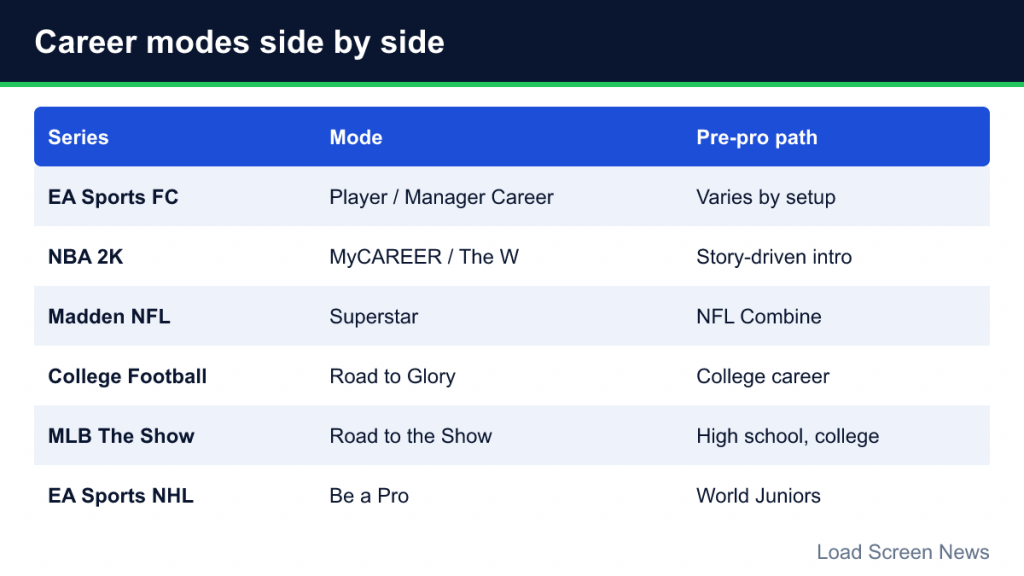
| Series | Mode | Pre-pro path | Standout trait |
|---|---|---|---|
| EA Sports FC | Player Career / Manager Career | Varies by setup | Player and manager careers in one game; Dynamic OVR in FC 27 |
| NBA 2K | MyCAREER / The W | Story-driven intro | Deep builder, online City hub |
| Madden NFL | Superstar | NFL Combine | Position choice changes everything |
| College Football | Road to Glory | College career | College atmosphere and progression |
| MLB The Show | Road to the Show | High school and college | College World Series, calm pacing |
| EA Sports NHL | Be a Pro | World Juniors | Draft position shaped by performance |
Progression Systems: What to Watch For
Progression is where career modes differ most, and it shapes how the mode feels over many hours.
- Performance-based progression rewards playing well. It feels natural but can be slow if you are still learning the controls.
- Training and drills offer a reliable way to improve specific attributes between matches.
- Currency-based progression, as in NBA 2K’s VC, lets you buy attribute upgrades. Because VC can also be purchased, it is worth checking how the current edition balances earning and buying before you commit.
- Archetypes and caps limit how far certain skills can go, which encourages specialization and makes builds matter.
A general tip: in most career modes, playing on a slightly lower difficulty in your first season helps you earn better ratings while you learn, which speeds up progression. Raise it once your player establishes themselves.
Which Career Mode Should You Try?
- You want a story and a social hub: NBA 2K’s MyCAREER.
- You want a calm, strategic experience: MLB The Show’s Road to the Show.
- You want to run a club rather than play as one person: EA Sports FC Manager Career, or the franchise modes covered in a separate guide.
- You love a particular position: Madden Superstar as a quarterback or NHL Be a Pro as a goalie offers a focused, distinctive experience.
- You love college atmosphere: College Football’s Road to Glory.
Online Connections and Offline Play
Career modes vary in how much they depend on an internet connection. Manager-style careers and most baseball and hockey careers are essentially single-player experiences. NBA 2K’s MyCAREER is the exception that leans hardest on online features, because The City and its courts are shared spaces with other players. If you play mostly offline or have an unreliable connection, check what parts of a mode need servers before investing many hours, and remember that publishers eventually switch off online services for older editions.
Common Mistakes in Career Modes
- Choosing a build you cannot play. Pick a position that suits your skills, not just the one that looks most glamorous.
- Chasing the ball. In team sports, leaving your position hurts your ratings and your team.
- Skipping training. Drills are often the most efficient path to improvement.
- Simulating too much. Simulated games can produce weaker progression than played ones in many modes.
Career modes are slow-burn experiences. The reward is not a single great match but the arc of a whole career, from an unknown prospect to a recognized star. Give your player time, and the mode will reward your patience.