Franchise Modes Explained: Running a Team Across Multiple Seasons
How franchise and dynasty modes work in Madden, MLB The Show, NHL, NBA 2K and College Football: rosters, salary caps, contracts, drafts, scouting and sims.
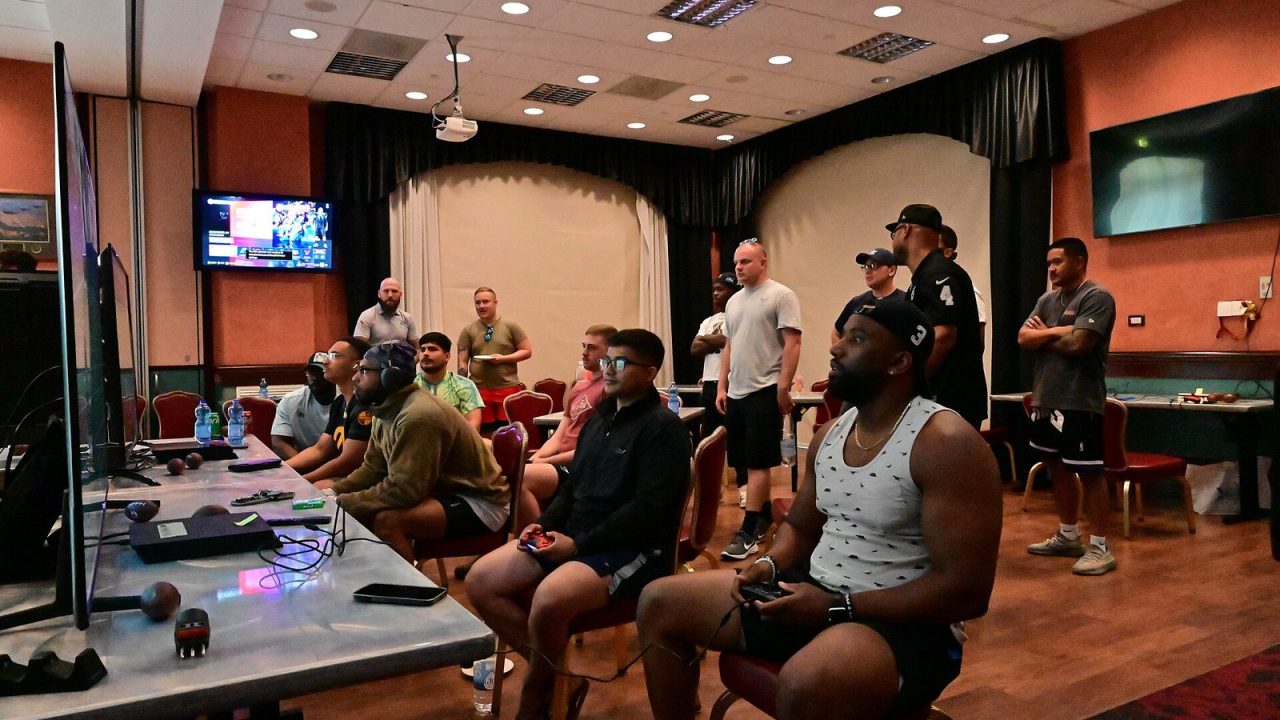
For many players, the deepest part of any sports game is not a single match but the long game: building a team over years, drafting a rookie who becomes a star, making the trade that wins a title, or rebuilding a struggling club from the ground up. That is the territory of franchise and dynasty modes.
This guide explains how these modes work, what systems they share, and how the major series differ as of October 2026. If you are more interested in playing as one athlete, our guide to career modes in sports games covers that side of things.
What a Franchise Mode Is
In a franchise mode you take control of an organization rather than a single player. Your job usually combines several roles:
- General manager: roster building, contracts, trades and the draft.
- Coach: depth charts, lineups, tactics and playing time.
- Sometimes owner: finances, ticket prices, stadiums or relocation, depending on the series.
You can usually play every game yourself, play only key games, or simulate whole weeks and seasons. That flexibility is what makes franchise modes so popular: some players treat them as a sports management game, while others use them as a framework for playing a full season with meaning behind every match.
The Building Blocks Shared by Every Series
Rosters and depth charts
Your roster is everyone under contract; the depth chart or lineup decides who actually plays. Managing playing time matters because it affects player development, morale and, in some games, fatigue and injury risk.
Salary cap or budgets
American leagues use salary caps, which limit how much a team can spend on player salaries. Games model these rules to varying degrees, so you cannot simply sign every star. In football’s EA Sports FC Manager Career, the constraint is instead a transfer budget and wage budget set by your club’s board.
Contracts and free agency
Players have contracts with lengths and salaries. When contracts expire, players may re-sign or hit free agency. Negotiations consider money, years, team quality and sometimes the player’s personality.
Trades
Trades let you exchange players and draft picks. Games use AI logic to value players and prevent obvious exploits, although every series tunes this differently and many offer settings to make the AI stricter or more lenient.
Draft and scouting
American sports games include a yearly draft of amateur players. Scouting reveals information about prospects over the season, so you are never fully certain what you are drafting. That uncertainty creates some of the best stories in these modes.
Player development
Young players improve through playing time, training and potential ratings, while veterans eventually decline. Balancing win-now moves with long-term development is the central strategic tension of every franchise mode.
Madden NFL Franchise
Madden’s Franchise mode lets you take control of an NFL team across many seasons, handling the roster, contracts, the draft and weekly game plans. American football’s large rosters make depth management and the salary cap especially important; a team can only afford a few star contracts.
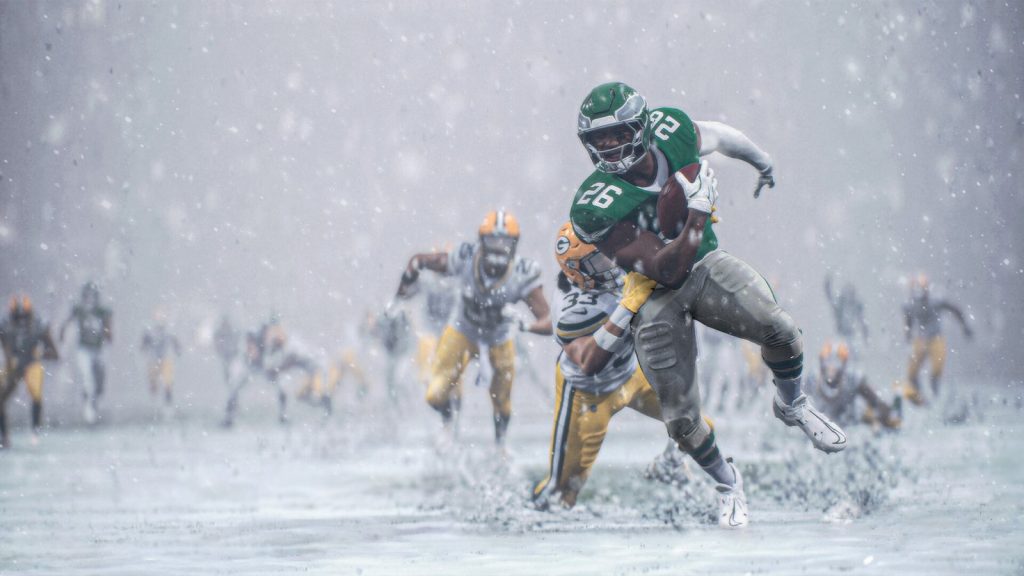
Madden NFL 27, released in August 2026, introduced a “persona engine” that EA describes as its biggest change to how players behave, negotiate and handle free agency and news. Player contracts are also more detailed than in previous editions. The practical effect is that negotiations and roster moves depend more on individual personalities rather than only on ratings and money.
MLB The Show Franchise
MLB The Show’s Franchise mode puts you in charge of a Major League Baseball organization over multiple seasons. Baseball adds a unique layer: the minor leagues. You manage prospects across affiliated levels, deciding when a young player is ready for promotion.
In MLB The Show 26, released in March 2026, Franchise received updated roster management and trading tools, including a Trade Hub. The series also offers shorter alternatives for players who do not want a full multi-season commitment, along with single-game and single-season play.
Baseball’s long season means simulation is central. Most players simulate stretches of games and step in for key series or particular pitchers’ starts. Pitching staffs, with starters on rotation and bullpen arms needing rest, add a level of lineup management that other sports do not have.
EA Sports NHL Franchise
NHL’s franchise suite covers running a hockey club through trades, contracts, scouting and the draft, plus line combinations for forwards and defense pairs. Hockey adds concerns such as line chemistry and goalie workload.
NHL 27 also offers Connected Franchise, a multiplayer version in which many users each manage a franchise in the same league, making trades and competing against each other over a shared season. Online leagues like this turn franchise play into a social experience, with human general managers instead of AI.
NBA 2K MyNBA and MyWNBA
NBA 2K’s franchise mode is called MyNBA. Historically, 2K offered separate modes such as MyGM and MyLEAGUE; on the PS5 and Xbox Series X|S version of NBA 2K21, these were combined into MyNBA. Basketball’s small rosters make every contract decision significant, and the NBA’s salary rules, including the luxury tax, shape team building.
MyNBA’s standout feature is Eras, introduced in NBA 2K23. It lets you start a league in historical periods, initially the 1983–84, 1991–92 and 2002–03 seasons as well as the modern era, with period-appropriate presentation, arenas, logos and rules. Later editions added further eras, such as the “Steph Era” beginning in the 2016–17 season in NBA 2K25. Eras is a playground for alternate history: you can change how legendary teams were built.
In NBA 2K27, MyWNBA brings MyNBA’s full feature set, including adjustable simulation and franchise-altering mechanics, to the WNBA.
College Football Dynasty
College football’s Dynasty mode is a distinct beast because there is no draft and no salary cap. Instead, the lifeblood of a program is recruiting: convincing high school players to choose your school. Players graduate or leave, so a college roster turns over constantly, and the challenge is maintaining talent year after year.
Dynasty returned with College Football 25 in July 2024, after more than a decade without a college game from EA. College Football 27, released July 9, 2026 and the first in the series on PC, includes Dynasty along with a Coach Mode within it.
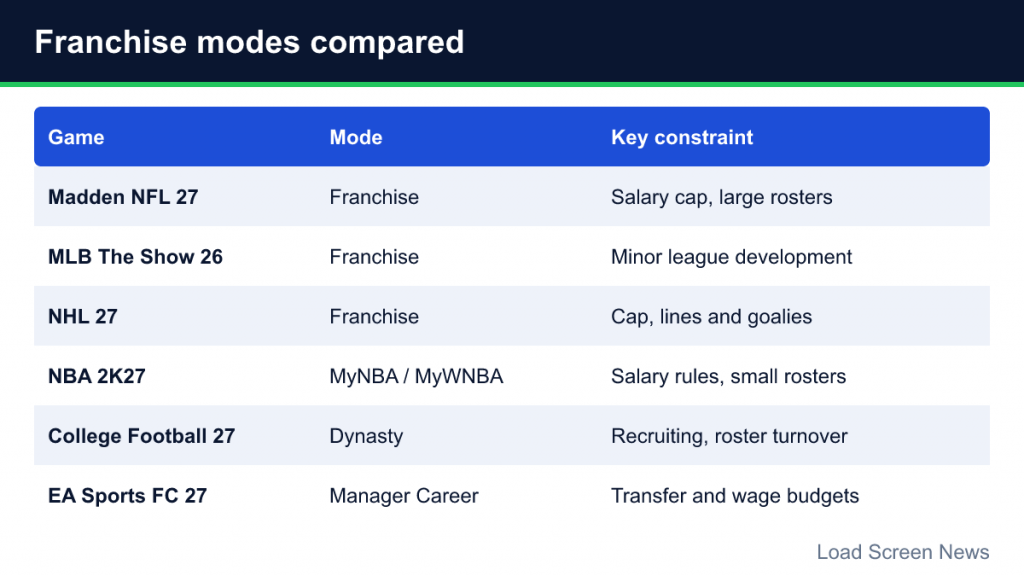
Comparing the Franchise Modes
| Series | Mode | Key constraint | Distinctive feature |
|---|---|---|---|
| Madden NFL 27 | Franchise | Salary cap, large rosters | Persona engine for negotiations and free agency |
| MLB The Show 26 | Franchise | Minor league development, pitching staff | Trade Hub, deep farm systems |
| NHL 27 | Franchise / Connected Franchise | Cap, lines and goalie management | Multi-user online leagues |
| NBA 2K27 | MyNBA / MyWNBA | Salary rules, small rosters | Historical Eras |
| College Football 27 | Dynasty | Recruiting and roster turnover | No draft or cap; Coach Mode |
| EA Sports FC 27 | Manager Career | Transfer and wage budgets | Rebuilt transfer market, Dynamic OVR |
Multi-Season Simulation: How to Use It Well
Simulation is a core tool, but it has quirks worth understanding:
- Sim results follow ratings and settings. Simulated games use the game’s internal model, which may differ from how you play. A team that wins when you control it may struggle in simulation, and vice versa.
- Injuries happen in simulation too. Check your roster after every simulated stretch.
- Use settings. Most series offer options for trade difficulty, injury frequency, progression speed and sim style. Adjusting these is how players create a “realistic” or a “relaxed” league.
- Save before big decisions. Many players keep backup saves before deadlines and drafts, especially in long-term leagues.
Strategy Basics for Your First Franchise
- Decide your timeline. Are you contending now or rebuilding? Mixed strategies tend to produce mediocre teams.
- Protect your young core. Young players on affordable contracts are the most valuable assets in capped leagues.
- Do not overpay aging stars. Long contracts for declining players can cripple a cap for years.
- Use the draft or recruiting consistently. Talent pipelines win in the long run.
- Watch depth. Injuries will happen, so backups matter more than many beginners expect.
Playing Every Game vs. Managing Only
There is no correct way to approach a franchise save, but it helps to choose a style before you start, because it affects which settings you should use.
- Play every game: the most immersive approach, but a full season takes a long time. Shorter quarter, period or half lengths keep it manageable, and many players adjust gameplay sliders so statistics stay realistic over shorter games.
- Play key games only: simulate most of the schedule and step in for rivalries, playoff races or postseason games. This is a popular middle ground.
- Manage only: simulate everything and focus on front-office decisions. In this style the simulation engine becomes the whole game, so settings for trades, progression and injuries matter most.
Whichever style you pick, keep notes. Long saves cover many seasons, and remembering why you drafted a player or signed a contract makes the story of your franchise far more rewarding.
Common Franchise Mode Mistakes
- Trading for ratings alone. Contracts, age and fit matter as much as overall rating.
- Ignoring morale and personalities. Modern modes increasingly model how players react to playing time and team success.
- Simulating without checking. Long sims can quietly ruin a depth chart through injuries.
- Exploiting the AI. Lopsided trades may be possible, but they often make a save feel hollow. Many players set stricter trade logic for a more satisfying challenge.
Franchise modes reward patience and planning more than any other part of sports games. The joy is in watching a long-term plan come together, often over many in-game seasons.