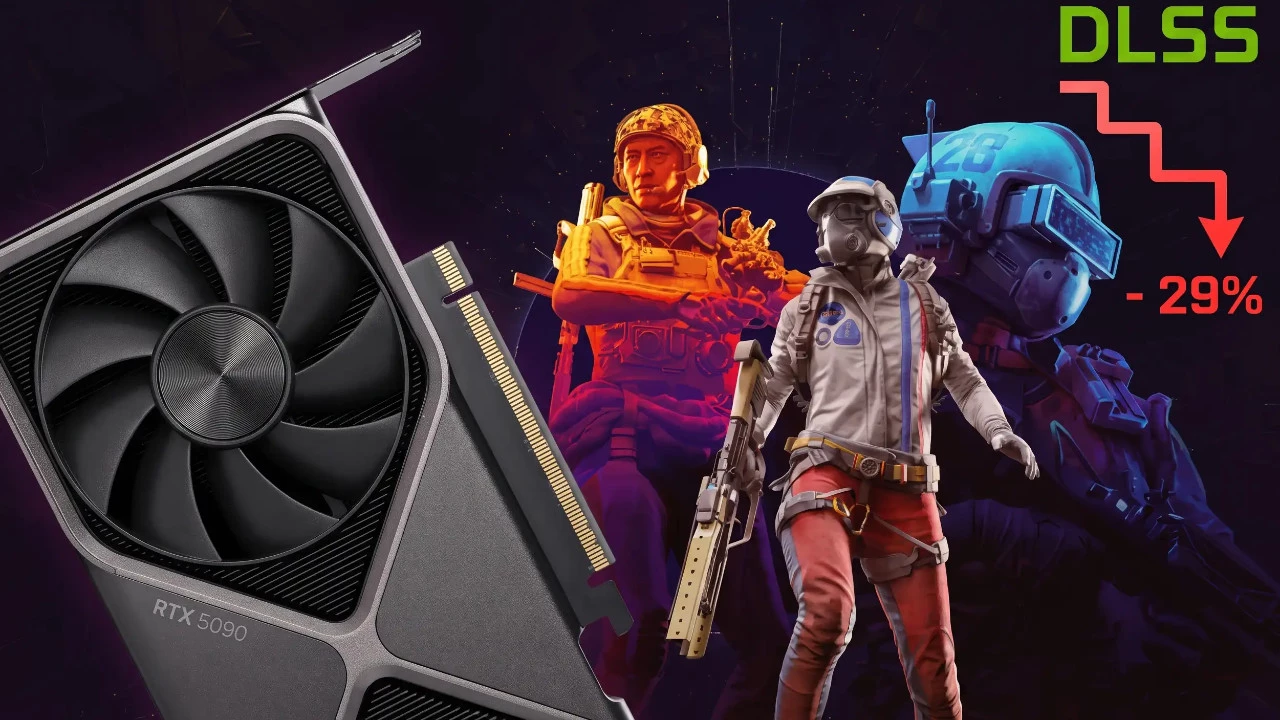
Recent benchmark tests and performance analysis of NVIDIA’s flagship GeForce RTX 50 series graphics cards, including the highly anticipated RTX 5090, have revealed an unexpected issue when utilizing the company’s intelligent upscaling technology. According to detailed testing conducted by hardware analysts, these cutting-edge GPUs may experience significant performance degradation of up to 29% when running games with DLSS (Deep Learning Super Sampling) enabled under certain conditions, pointing to a potential architectural weakness in the Blackwell-based processors.
Understanding the Performance Anomaly
The performance discrepancy appears to be linked to how the RTX 50 series handles memory bandwidth allocation when DLSS frame generation and upscaling are actively engaged. NVIDIA’s DLSS technology has been a cornerstone of the company’s gaming strategy since its introduction with the RTX 20 series in 2018, using dedicated Tensor cores to reconstruct higher-resolution images from lower-resolution renders. However, the new Blackwell architecture seems to encounter bottlenecks when the AI-driven processing competes with traditional rendering workloads for memory resources. Independent testers have documented scenarios where enabling DLSS Quality mode actually resulted in lower frame rates compared to native rendering, a paradox that contradicts the fundamental purpose of the technology.
The issue becomes particularly pronounced in memory-intensive gaming scenarios, such as open-world titles with extensive texture streaming or games utilizing ray tracing alongside DLSS. Analysts suggest that the RTX 5090’s 32GB of GDDR7 memory, while impressive on paper, may not be efficiently utilized when multiple AI-accelerated features operate simultaneously. This represents a significant concern for consumers who have invested substantial sums in these premium graphics cards, with the RTX 5090 commanding prices well above $1,999 at launch.
Historical Context and NVIDIA’s Upscaling Journey
NVIDIA’s journey with AI-powered upscaling began with the Turing architecture and has evolved considerably over subsequent generations. DLSS 1.0 was met with mixed reception due to image quality concerns, but DLSS 2.0 and subsequent iterations dramatically improved the technology’s reputation. The introduction of Frame Generation with DLSS 3.0 on the Ada Lovelace architecture (RTX 40 series) marked another significant milestone, allowing GPUs to synthesize entirely new frames using AI inference. The RTX 50 series was expected to refine these capabilities further with DLSS 4, introducing Multi Frame Generation that promised to generate up to three additional frames for every traditionally rendered frame.
Industry experts have noted that this aggressive approach to AI-assisted rendering may have pushed the architecture beyond its optimal operating parameters. The Tensor cores in Blackwell GPUs, while more powerful than their predecessors, appear to create memory access patterns that conflict with the GPU’s rendering pipeline under specific workloads. Some analysts have drawn comparisons to similar growing pains experienced by AMD’s FSR technology during its early implementations, suggesting that driver optimizations may eventually address the performance anomalies.
Implications for Gamers and the Industry
For consumers who have already purchased RTX 50 series cards or are considering doing so, the implications of these findings are significant but not necessarily catastrophic. The 29% performance loss represents a worst-case scenario observed in specific titles under particular conditions, and many games continue to show the expected performance improvements when DLSS is enabled. NVIDIA has historically been responsive to performance issues identified by the community, and driver updates addressing memory management inefficiencies could potentially resolve or mitigate the problem. However, if the issue stems from fundamental architectural decisions rather than software optimization, hardware-level solutions may not be possible for current-generation cards.
The competitive landscape adds additional pressure on NVIDIA to address these concerns promptly. AMD’s upcoming RDNA 4 architecture and Intel’s evolving Arc graphics division are both positioned to capitalize on any perceived weaknesses in NVIDIA’s flagship offerings. As graphics cards continue to incorporate more AI-driven features, the balance between traditional rasterization performance and machine learning workloads will become increasingly critical to overall gaming experience.
Expert Opinion: This architectural bottleneck likely stems from the aggressive implementation of Multi Frame Generation in DLSS 4, which places unprecedented demands on memory bandwidth that the current Blackwell design wasn’t fully optimized to handle simultaneously with intensive rendering workloads. NVIDIA will almost certainly address the most severe cases through driver updates within the next 2-3 months, but achieving optimal performance may require game-specific optimizations. Prospective buyers should wait for these driver improvements before making purchase decisions, as the true performance potential of RTX 50 series cards may not be fully realized until mid-2025.