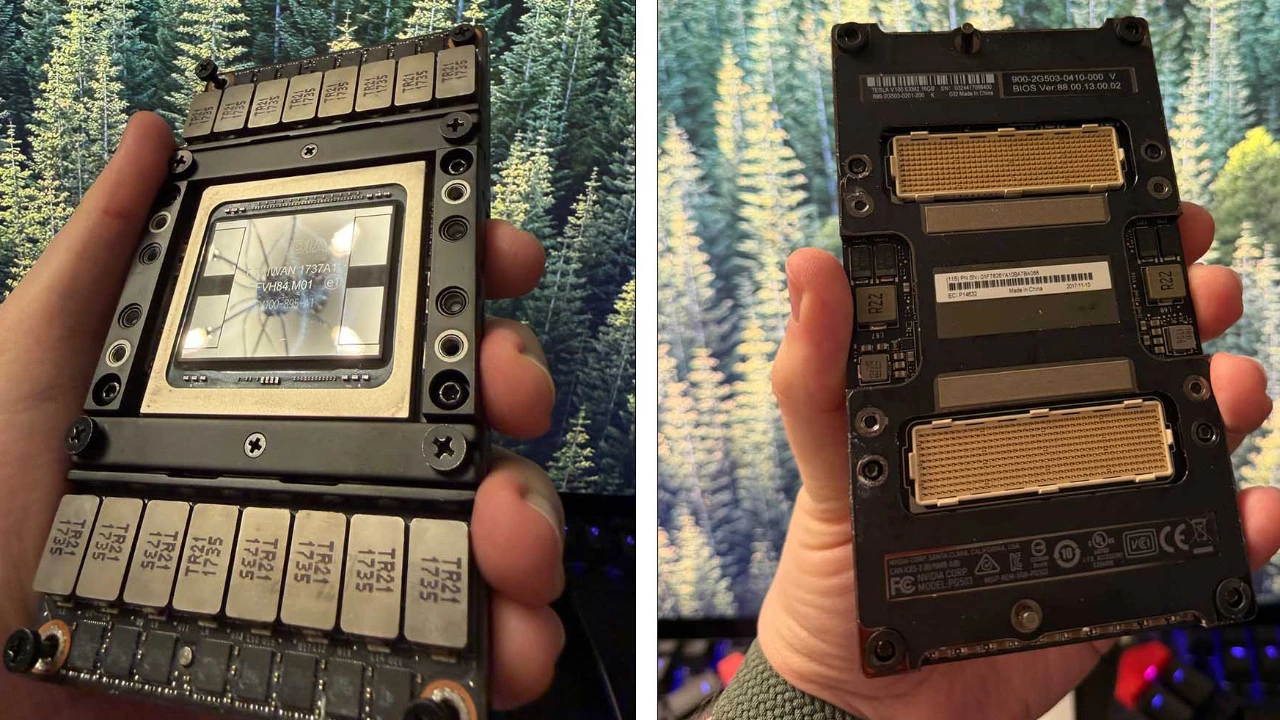
In the ever-evolving world of artificial intelligence and machine learning, enthusiasts are constantly pushing the boundaries of what’s possible with consumer hardware. A creative modder known online as Tymscar has captured the attention of the tech community by solving a common problem faced by AI hobbyists: the chronic shortage of video memory needed to run heavy AI models locally. His solution? Installing a professional-grade NVIDIA Tesla V100 server accelerator alongside his gaming RTX 4080 graphics card in a single desktop PC system.
The project highlights a growing trend among AI enthusiasts who are increasingly frustrated by the limitations of consumer graphics cards when it comes to running large language models, image generators, and other demanding AI workloads. While gaming GPUs like the RTX 4080 offer impressive performance, their 16GB of VRAM often falls short when attempting to load and run state-of-the-art AI models that can require 32GB, 48GB, or even more memory to operate effectively.
The Technical Challenge of Mixing Server and Consumer Hardware
The Tesla V100, originally designed for data center environments and professional AI research, represents one of NVIDIA’s most capable compute accelerators. Released in 2017 as part of the Volta architecture, the V100 was groundbreaking for its time, featuring 32GB of high-bandwidth HBM2 memory and exceptional performance for deep learning tasks. However, integrating such hardware into a consumer PC presents numerous challenges that would deter most users.
Server-grade accelerators like the Tesla V100 are designed for specialized chassis with specific cooling solutions, power delivery systems, and airflow configurations. They typically lack display outputs since they’re intended purely for compute tasks, and they require specific driver configurations that differ from gaming-oriented GeForce cards. Tymscar’s successful integration demonstrates both technical skill and determination, as he had to address power requirements that can exceed 300 watts for the V100 alone, cooling challenges since server cards often rely on chassis-wide airflow rather than individual fans, and driver conflicts when running both a Tesla compute card and a GeForce gaming GPU simultaneously.
Why Enthusiasts Are Turning to Creative Solutions
The rise of accessible AI tools like Stable Diffusion, LLaMA-based language models, and various open-source AI projects has created unprecedented demand for powerful local computing resources. While cloud computing offers one solution, many enthusiasts prefer running AI models locally for reasons including privacy concerns, avoiding ongoing subscription costs, the desire for unlimited experimentation without usage fees, and the simple satisfaction of owning capable hardware.
The VRAM bottleneck has become particularly acute as AI models continue to grow in size and complexity. Modern large language models can require anywhere from 8GB for heavily quantized versions to over 100GB for full-precision implementations of the largest models. This has created a secondary market for older professional cards like the Tesla V100, P40, and similar accelerators, which offer large memory pools at prices significantly below current professional offerings. A used Tesla V100 with 32GB of HBM2 memory can often be found for a fraction of its original price, making it an attractive option for budget-conscious AI enthusiasts willing to tackle the integration challenges.
The Broader Implications for AI Accessibility
Tymscar’s project represents more than just a clever hardware hack—it symbolizes the democratization of AI computing that’s occurring across the tech landscape. As AI capabilities become increasingly important for various applications, from creative tools to productivity enhancement, the gap between professional and consumer hardware becomes more significant. Projects like this demonstrate that determined individuals can bridge that gap through creativity and technical knowledge.
The community response to such modifications has been largely positive, with many expressing interest in replicating similar setups. Online forums and communities dedicated to local AI deployment have seen increased discussion about hybrid configurations that combine gaming GPUs for everyday use with compute accelerators for AI workloads. This trend may influence future hardware development, potentially leading manufacturers to create more accessible solutions for the growing AI enthusiast market. As artificial intelligence continues to integrate into daily computing tasks, the demand for capable local hardware will only increase, making creative solutions like Tymscar’s increasingly relevant to a broader audience.
Expert Opinion: This trend of repurposing enterprise-grade AI accelerators for consumer builds signals a significant shift in the hobbyist computing landscape. As AI model sizes continue to grow exponentially, we can expect NVIDIA and AMD to eventually bridge this gap with consumer products offering larger VRAM configurations. Until then, the secondary market for datacenter GPUs will likely remain strong, with prices potentially rising as more enthusiasts discover this workaround for the VRAM limitations plaguing current consumer offerings.