How Ultimate Team Modes Work: Cards, Chemistry and Squads Explained
A neutral guide to card-based team modes in FC, Madden, NHL, NBA 2K and MLB The Show: items, chemistry, challenges, currencies, odds disclosure and controls.

Card-collecting team modes are among the most played parts of modern sports games, and also among the most misunderstood. If you have ever opened EA Sports FC, Madden, NHL, NBA 2K or MLB The Show and wondered what all the cards, ratings and challenge menus are about, this guide explains the structure in plain terms.
We explain how the modes work. We do not give advice on spending, trading for profit or opening packs, and we cover the tools that publishers and console makers provide for keeping spending and playtime under control. For the bigger picture of each series, see our beginner’s guide to the major sports game series.
The Modes and Their Names
Each series uses its own branding, but the concept is the same: you build a team from individual player items rather than picking a real club’s roster.
| Series | Mode name |
|---|---|
| EA Sports FC | Football Ultimate Team (FUT) |
| Madden NFL | Madden Ultimate Team (MUT) |
| EA Sports NHL | Hockey Ultimate Team (HUT) |
| NBA 2K | MyTEAM |
| MLB The Show | Diamond Dynasty |
The format began in football. Ultimate Team was introduced in FIFA 09, released in 2008, as downloadable content for PlayStation 3 and Xbox 360. Players built squads by opening card packs and buying, selling and auctioning cards. NBA 2K’s MyTEAM arrived with NBA 2K13, and Diamond Dynasty in MLB The Show is built around cards of current players and MLB legends.
Player Items: What a “Card” Actually Is
A player item represents a real athlete (or a legend) with a set of ratings. Several versions of the same player often exist: a base item reflecting their standard ratings and special items released during a season to mark events, form or themed promotions. Special items typically have higher ratings or different attributes.
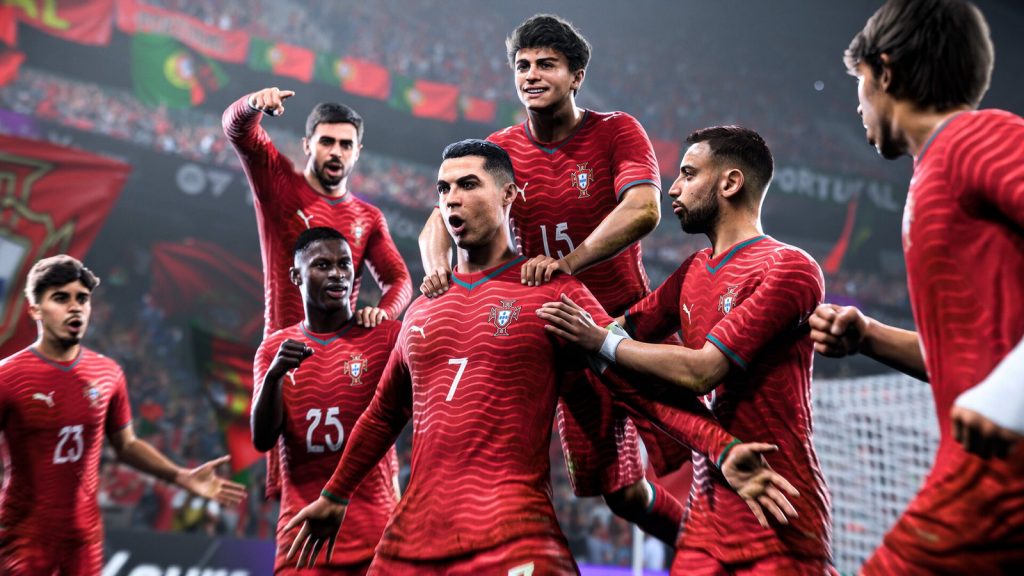
Items usually show:
- An overall rating summarizing the player’s quality in their position.
- Attribute ratings such as pace, shooting or passing in football, or contact and power in baseball.
- Position and secondary positions, which determine where the item fits in your lineup.
- Extras specific to each series, such as PlayStyles in EA Sports FC, abilities in Madden or badges in NBA 2K.
- Tradeability. Some items can be listed on an in-game market; others are untradeable, often because they were earned as rewards.
Beyond players, the modes include other item types: managers or coaches, stadiums, kits, badges and consumables. In EA Sports FC 25, Player Roles from the FC IQ tactical system were made part of each player item, and manager items carry the manager’s tactical preferences.
Chemistry and Synergy
Chemistry systems reward building a team that makes sense together, rather than simply collecting the highest-rated players. The rules vary by series and change over time.
In EA’s football mode, chemistry is based on links between players through shared club, league and nation, and on whether a player is in a suitable position. The system was overhauled in FIFA 23 and again in EA Sports FC 24, which removed the requirement for players to be in adjacent positions to link with each other. In practice, chemistry encourages building around a league or nation and makes the puzzle of squad building more interesting.
Other series handle team synergy in their own ways, and those mechanics are revised regularly; some lean on player abilities or badges rather than football-style links. Always check the in-game help for the current edition, since chemistry rules are one of the things developers adjust most often between years.
Ways to Play: Solo and Online
A common assumption is that these modes are purely online and competitive. In reality, most of them include substantial solo content.
Solo and offline-style content
- Objectives: tasks such as scoring a certain number of goals with specific players, completed across modes for rewards.
- Matches against the AI: most of these modes offer games against computer-controlled squads, so you can progress without facing human opponents.
- Programs and seasonal content: in Diamond Dynasty, programs and modes such as Conquest let players progress against the CPU.
Online competition
- Ranked divisions, such as Division Rivals in EA Sports FC. In FC 25, Division Rivals switched to a points system with 3 points for a win and 1 for a draw.
- Tournament formats such as weekend competitions or gauntlet-style events. EA Sports FC 26 added Gauntlets, tournaments that require you to change your team every game.
- Smaller-sided formats. Rush, introduced in FC 25, offers 5v5 matches with AI goalkeepers in which up to four friends can team up.
Squad Building Challenges and Evolutions
Many modes include challenges in which you submit a group of items that meet certain requirements, such as a minimum team rating or players from a specific league, in exchange for a reward. EA Sports FC calls these Squad Building Challenges (SBCs). They are essentially puzzles that turn surplus items into something new.
Upgrade systems are a newer addition. Evolutions, added in EA Sports FC 24, let players upgrade certain items by completing objectives with them. In FC 25 EA added cosmetic Evolutions that change an item’s appearance, and FC 27 introduced a Campaign Hub that groups themed objectives, squads, Evolutions and tokens in one place. Similar progression ideas appear in other series, where items can be leveled or upgraded through play.
Currencies: Earnable and Purchasable
Card modes usually separate two kinds of currency:
- Earnable currency, such as coins in EA’s modes or Stubs in MLB The Show, which you gain by playing matches and completing objectives.
- Premium currency, such as FC Points in EA Sports FC, which can be bought with real money. In NBA 2K, Virtual Currency (VC) is used across several modes and can be earned or bought.
Rewards earned through play include packs, players, currency and cosmetic items. Packs contain random items, which is why these modes carry content labels for “In-Game Purchases” and “Paid Random Items.” Rules on paid random items differ by country: Belgium banned packs of this type, and regulators in the Netherlands initially fined EA.
Every one of these modes can be played without spending money. How quickly you progress without spending varies by series and by the time you put in, and many players deliberately stick to earned rewards and solo content.
Pack Probability Disclosure
Publishers now show the odds for packs sold for premium currency. EA’s official explanation for EA Sports FC is a useful example of how this works:
- Each pack in the Ultimate Team Store that is available for FC Points has a “Show Pack Probabilities” option.
- The percentages show the minimum chance of receiving one or more items in a listed category, such as a certain item type and overall rating range.
- Each pack opening is independent; odds do not build up across packs.
- EA calculates the figures by simulating a very large number of pack openings and re-runs the process with each content update, so probabilities can change during a season.
- Some categories of rare content can have probabilities below 1%.
EA also introduced pack previews in June 2021, letting players preview one pack per day before opening it. The key takeaway is that rare items are, by design, rare, and the odds screen exists so players can see that before making any decision.
Spending and Playtime Controls
Whether you are an adult setting your own limits or a parent managing a child’s account, several layers of controls exist.
In-game tools
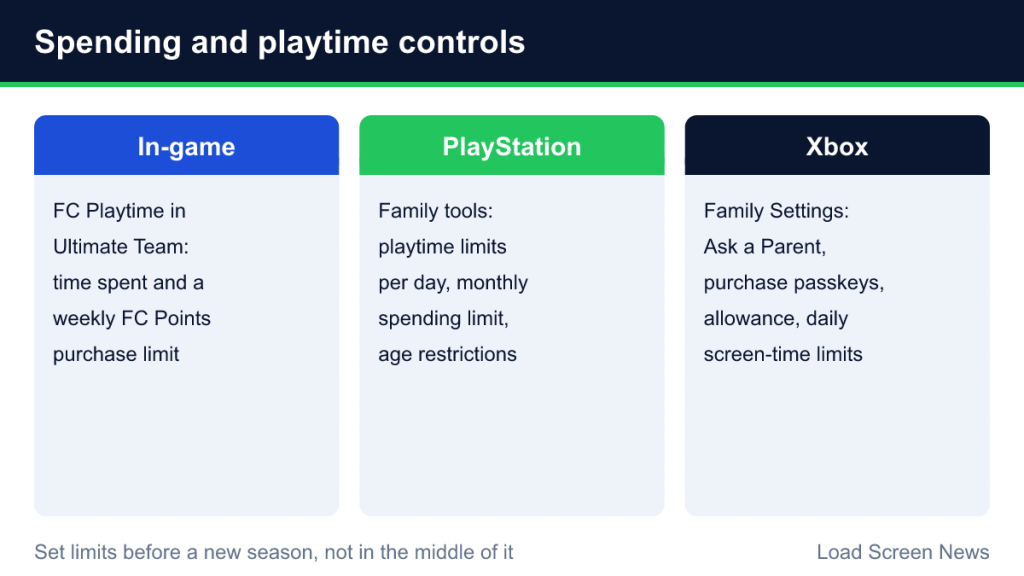
EA Sports FC includes a feature called FC Playtime in its Ultimate Team settings, which shows time spent and lets players set a weekly limit on how many FC Points they can purchase.
PlayStation
The PlayStation Family tools let a parent set playtime limits for each day of the week, choose whether play is blocked or just a reminder appears when time runs out, and set a monthly spending limit for PlayStation Store purchases on a child’s account. Age-based content restrictions and communication settings are also available.
Xbox
Xbox Family Settings, available as a phone app and through a Microsoft family account, include “Ask a Parent” purchase requests, purchase passkeys, an allowance system, purchase history, daily screen-time limits and limits for specific games. Microsoft also publishes loot box policies for parents.
Good habits for everyone
- Set limits before you start a new season of a mode, not in the middle of it.
- Remember that the core gameplay, career and franchise modes contain no random paid items at all.
- Read the odds screen before any purchase involving random items.
Glossary
- OVR: overall rating.
- Chemistry: a bonus system for building a coherent squad.
- SBC: Squad Building Challenge; submit items that meet requirements to receive a reward.
- Objectives: tasks that grant rewards for playing in specific ways.
- Untradeable: an item that cannot be listed on the in-game market.
- Program: in Diamond Dynasty, a reward track tied to a theme or season.
- Icons / Legends: items representing retired players.
Is This Mode for You?
Card modes suit players who enjoy collecting, building and tinkering with lineups, and who like a steady stream of goals and challenges. They are less suited to anyone who wants an authentic season with real rosters, which franchise and career modes deliver better. Many players treat card modes as a side activity: a few objectives here, a squad challenge there, while their main focus stays on a franchise or career save.
If you do play, treat it like any hobby with a budget: decide your limits up front, use the tools described above, and focus on the parts of the mode you enjoy rather than chasing every new release.