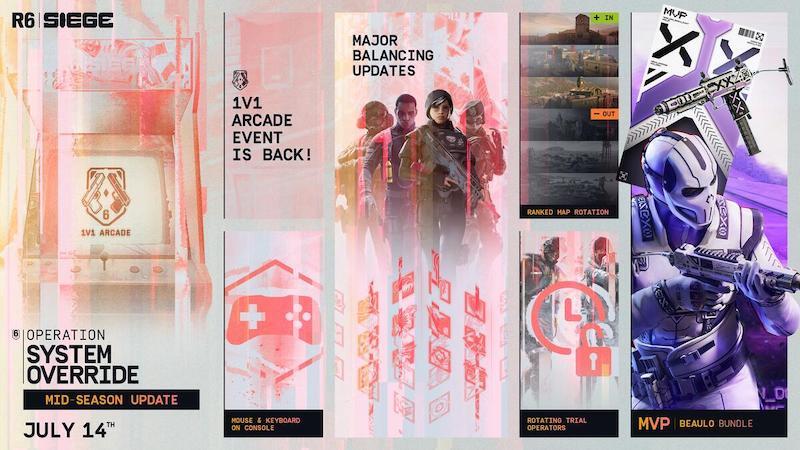
Operation System Override took Rainbow Six Siege by storm when it launched on June 2, 2025, introducing a comprehensive Dokkaebi rework, the reimagined Calypso Casino map, and a groundbreaking competitive overhaul with Ranked 3.0. The seasonal update represented one of the most significant changes to the tactical shooter in recent memory, fundamentally altering how players approach both casual and competitive gameplay. Now, as the season reaches its midpoint, Ubisoft’s development team is rolling out an extensive array of additional changes that promise to reshape the meta once again, including critical Operator balancing adjustments, native mouse and keyboard support for console players, a returning fan-favorite limited-time event, a refreshed Ranked map rotation, and a new rotating Operator trial system designed to give players more flexibility in their tactical choices.
1v1 Arcade Mode Returns with Major Improvements
The beloved 1v1 Arcade limited-time event has made its triumphant return, transforming Siege’s methodical tactical gameplay into a fast-paced, adrenaline-fueled dueling environment. This mode strips away the team-based dynamics that define traditional Siege matches, creating a pure test of individual skill where players must rely solely on their gunplay precision, movement mechanics, and gadget mastery. The development team has implemented significant changes based on extensive community feedback from previous iterations, focusing on reducing downtime between matches and introducing greater variety to keep the experience fresh and engaging throughout its two-week run.
Notable improvements to this iteration include a substantially expanded map pool, with the total number of available maps increasing from three to five. House has been removed from rotation, while Coastline, Consulate, and Outback have been added to provide more diverse combat environments. The competitive structure has also been refined with several quality-of-life improvements: bomb sites are now automatically revealed to eliminate reconnaissance delays, prep phase duration has been reduced for faster match starts, and an innovative attrition system has replaced traditional Operator bans. Under this new system, winning players can no longer select the Operator they used in the previous round, forcing continuous adaptation and preventing dominant strategies from becoming stale. Perhaps most significantly, the mode now utilizes the Ranked skill table for matchmaking rather than Quick Match data, ensuring more balanced and competitive pairings across all skill levels.
Comprehensive Operator Balancing Changes
The mid-season update introduces a sweeping series of Operator adjustments designed to improve competitive fairness, enhance versatility, and more clearly define each character’s role within team compositions. Dokkaebi, who received a major rework at the season’s launch, continues to be fine-tuned with changes to her global cooldown mechanics. The blanket cooldown has been removed entirely, replaced with a target-specific cooldown system that allows for more strategic deployment of her Jegeo Payload. However, this increased flexibility comes with an extended cooldown duration of 14 seconds, doubled from the previous 7 seconds, requiring players to be more deliberate in their ability usage.
Wamai emerges as one of the biggest winners in this update, receiving substantial buffs that significantly enhance his defensive capabilities. His Mag-NET activation time has been dramatically reduced from 1.5 seconds to just 0.5 seconds, enabling much faster projectile interception that could prove crucial in high-pressure situations. The charge regeneration rate has been halved from 40 seconds to 20 seconds per charge, and his maximum charges have increased from 5 to 7, making him a far more potent alternative to Jäger for projectile denial. Additionally, Wamai gains access to a deployable shield as a secondary gadget option, while Impact Grenades have been replaced with a Nitro Cell, dramatically expanding his tactical utility. Speaking of Jäger, the German defender has been converted to a 3 Speed / 1 Armor profile from his previous 2/2 configuration, fundamentally changing his playstyle to favor aggressive roaming and rapid repositioning over sustained firefights.
Attacking Operators have also received notable adjustments. Zofia’s KS79 Lifeline launcher now carries increased ammunition, with both Concussion Grenades and Impact Grenades increased from 2 to 3 rounds each, substantially boosting her entry fragging and soft destruction capabilities. Twitch’s Shock Drone shot recharge time has been slightly reduced from 30 to 28 seconds, while Rauora benefits from a significant cooldown reduction between gadget shots, dropping from 3 seconds to just 1 second. On the defensive side, Lesion’s GU Mine refill time decreases from 30 to 25 seconds, and Melusi’s Banshee area of effect expands slightly from 4 meters to 4.3 meters. The 416-C Carbine, used by multiple Operators, receives improvements to both vertical and horizontal recoil patterns.
Native Mouse and Keyboard Support Arrives on Consoles
In a move that acknowledges the evolving landscape of competitive gaming, Ubisoft has officially implemented native mouse and keyboard support for console versions of Rainbow Six Siege. This comprehensive integration covers all aspects of the game, including gameplay mechanics, user interface navigation, and system interactions. The addition of text chat functionality for squads containing mouse and keyboard players ensures seamless team communication regardless of input method. This implementation represents a significant shift in Ubisoft’s approach to input device parity across platforms, bringing console players who prefer traditional PC peripherals into a unified competitive ecosystem.
To maintain competitive integrity, the game features automatic input detection that identifies what device players are using and routes mouse and keyboard users into the PC crossplay matchmaking pool. This prevents the inherent precision advantages of mouse aiming from creating unfair matchups against controller users. The existing Mousetrap enforcement system remains active to catch players attempting to circumvent these matchmaking rules through adapter devices or other workarounds. This balanced approach allows players to enjoy their preferred input method while ensuring that competitive matches remain fair for all participants, regardless of their chosen platform or control scheme.
Ranked Map Rotation and Operator Trials
The mid-season update brings a refreshed Ranked map rotation designed to keep the competitive experience feeling dynamic and varied. Kanal, Villa, and Theme Park have been added to the rotation, while Coastline, Outback, and Emerald Plains have been temporarily removed. The Pro League and Showcased map pools remain unchanged, maintaining consistency for professional and aspiring competitive players. These rotations are essential for preventing meta stagnation and encouraging players to develop proficiency across a wider range of environments and strategic scenarios.
Additionally, Ubisoft has introduced a rotating trial Operator system that gives players the opportunity to test Operators they don’t currently own. Each week, three Attackers and three Defenders will be available for free use across multiple game modes, including Enlisted, Quick Match, Team Deathmatch, Unranked, Ranked, and Siege Cup matches. This week’s featured Operators include Gridlock, Montagne, and Flores on attack, with Ela, Azami, and Caveira available for defenders. This system not only helps newer players discover which Operators suit their playstyle before committing to a purchase but also allows experienced players to experiment with unfamiliar characters in meaningful competitive contexts. Rainbow Six Siege is available now on Steam, PlayStation, and Xbox platforms, with the mid-season update live across all supported systems.
Expert Opinion: The mid-season update demonstrates Ubisoft’s continued commitment to evolving Rainbow Six Siege’s competitive ecosystem nearly a decade after launch. The Wamai buffs and Jäger speed change could significantly shift defensive meta strategies, potentially reducing Jäger’s dominance while creating more viable alternatives for projectile denial. The native mouse and keyboard implementation for consoles, combined with proper matchmaking segregation, represents an industry-leading approach to cross-input fairness that other competitive titles should consider adopting.