From FIFA to EA Sports FC: The History of EA’s Football Series
How EA's football series grew from FIFA International Soccer in 1993 to EA Sports FC 27: key eras, the PES rivalry, Ultimate Team and the 2022 split with FIFA.
For three decades, a new EA football game every autumn has been as predictable as the start of the club season. The series began as FIFA International Soccer in 1993, grew into one of the best-selling franchises in video game history, and in 2023 changed its name to EA Sports FC after EA and FIFA ended their partnership. This article traces that journey, era by era, and explains how the licensing split actually worked.
If you are new to the current games, our EA Sports FC beginner’s guide covers the controls and modes of today’s edition.
1993: FIFA International Soccer
The series began with FIFA International Soccer, released on the Sega Mega Drive in December 1993. Developed by Extended Play Productions for EA, it was the first football game with an official license from FIFA, the sport’s world governing body. Its isometric viewpoint set it apart from the top-down and side-on football games common at the time.
Early editions were far from the fully licensed games of today: real player names only arrived with FIFA 96. Still, the combination of a famous name and presentation-focused design helped the game stand out, and EA released new editions regularly from then on.
The 1990s: Real Names, 3D and Road to World Cup 98
The mid-1990s brought rapid change:
- FIFA 96 added real player names through a license with FIFPro, the international players’ union, and introduced the “Virtual Stadium” 3D engine.
- FIFA 97 brought polygonal players and an indoor soccer mode.
- FIFA: Road to World Cup 98 is widely seen as the moment the series found its stride. It added a licensed soundtrack, which became a series trademark, and a properly implemented offside rule.
By 2000, the series had sold more than 16 million copies.
The 2000s: Growth and the PES Rivalry
The 2000s were defined by competition. Konami’s Pro Evolution Soccer (known as Winning Eleven in some regions) built a reputation among many players for deeper, more realistic gameplay, while FIFA held the advantage in official licenses and presentation. The rivalry pushed both series forward.
Key FIFA milestones of the decade included:
- FIFA 2001, the first PC version playable online, with official club emblems.
- FIFA Football 2002, which introduced power bars for passes.
- FIFA 06, which overhauled the game engine; its Xbox 360 version was the series’ first on that generation of hardware.
- FIFA 08, which introduced the “Be a Pro” mode, letting players control a single footballer, and arrived on PlayStation 3 and Wii.
- FIFA 09, which brought Ultimate Team as downloadable content for PS3 and Xbox 360.
2009: The Arrival of Ultimate Team
Ultimate Team began life as downloadable content for FIFA 09, released in 2008. Players built squads by opening card packs and buying, selling and auctioning cards with other players. The mode grew into the series’ centerpiece and was later copied across EA’s other sports games. It also attracted regulatory scrutiny over its paid random packs: Belgium banned such packs, and regulators in the Netherlands initially fined EA. Today the mode displays pack probabilities, and our neutral explainer on Ultimate Team modes covers how it works.
The 2010s: Commercial Dominance
The early 2010s were when FIFA pulled decisively ahead of PES commercially, helped by gameplay improvements that addressed the rival’s traditional strengths.
- FIFA 10 added 360-degree player control.
- FIFA 12 introduced the Player Impact Engine, Precision Dribbling and Tactical Defending, a system that gave equal weight to positioning, intercepting passes and tackling. It became the fastest-selling sports game, with more than 3.2 million copies sold in its first week.
- FIFA 14 introduced the Ignite engine on PlayStation 4 and Xbox One.
- FIFA 15 was the first released under EA’s deal with the Premier League that included all 20 league stadiums.
- FIFA 16 added women’s national teams for the first time.
- FIFA 17 moved to the Frostbite engine and introduced the series’ first story mode, “The Journey,” following the fictional footballer Alex Hunter.
- FIFA 19 added the UEFA club competitions, including the Champions League, after Konami lost the license in 2018.
- FIFA 20 introduced Volta Football, bringing back street-style small-sided play reminiscent of the earlier FIFA Street spin-offs.
The series’ cumulative sales reflected that dominance, passing 100 million by 2010 and more than 325 million by 2021.
FIFA 23: The Final FIFA
FIFA 23, released on September 27, 2022, was the last game under the EA–FIFA partnership. It was the first in the series with cross-play at launch and the first to include playable women’s club leagues, such as England’s Women’s Super League and the NWSL in the United States.
The Licensing Split Explained
On May 10, 2022, EA and FIFA announced that their licensing agreement would end on December 31, 2022, after a one-year extension that allowed FIFA 23 to be released. The parties had failed to agree on licensing terms, and EA announced that its football games would continue under a new name: EA Sports FC.
The key point for players is that the FIFA license was only one of many. EA’s real football content comes from separate agreements with leagues, clubs, competitions and players’ organizations. Those deals continued, so EA Sports FC launched with licenses covering more than 19,000 players, 700 teams, 100 stadiums and 30 leagues carried over from FIFA 23. What disappeared was mainly the FIFA name and FIFA-branded competitions.
FIFA itself has since moved into games with other partners. As of 2026, FIFA-branded titles such as FIFA Heroes have been released, separate from EA’s series.
The EA Sports FC Era
| Edition | Release | Notable additions |
|---|---|---|
| EA Sports FC 24 | September 29, 2023 | New chemistry rules, Evolutions in Ultimate Team, expanded cross-play including Clubs |
| EA Sports FC 25 | September 27, 2024 | FC IQ tactical system with Player Roles; Rush 5v5 mode |
| EA Sports FC 26 | September 26, 2025 | Competitive and Authentic gameplay presets; Manager Live Challenges |
| EA Sports FC 27 | September 25, 2026 | The Grounds social hub; rebuilt transfer market and Dynamic OVR in Career |
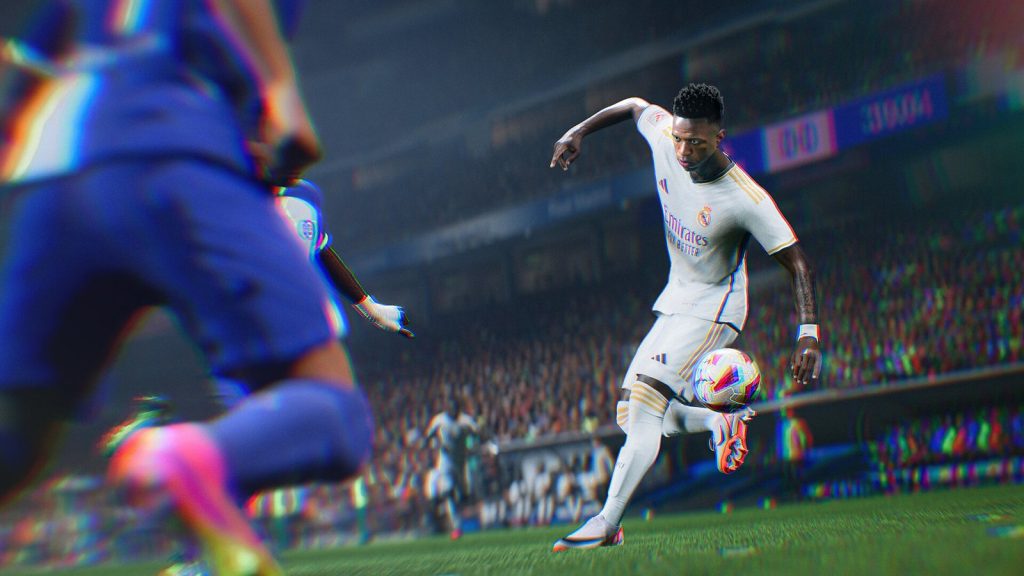
EA Sports FC 24 kept the familiar structure of Kick-Off, Career, Ultimate Team, Clubs and Volta while starting a new brand. FC 25 introduced FC IQ, a tactical system built around Player Roles, Team Tactics and Smart Tactics, along with Rush, a 5v5 format. FC 26 split gameplay into a faster Competitive preset for Ultimate Team and Clubs and a more realistic Authentic preset for Career Mode. FC 27, the current edition as of October 2026, brought social football together in The Grounds and made player ratings in Career change with form, morale and fitness.
The wider EA Sports FC brand also includes EA Sports FC Mobile and EA Sports FC Online, giving the series a presence beyond consoles and PC.
How the Gameplay Philosophy Evolved
Looking across the decades, the series’ gameplay has moved through clear phases. The 1990s games were arcade-flavored, built for quick goals and spectacle. The 2000s brought a gradual move toward realism, partly under pressure from PES, with power bars for passes and more deliberate build-up play. The FIFA 12 era made defending a skill rather than a button press, with Tactical Defending rewarding positioning and timing over constant pressing. Later engines, Ignite and then Frostbite, focused on more natural movement and presentation.
The EA Sports FC era has pushed in two directions at once. On one side, systems such as FC IQ’s Player Roles give tactics more depth than ever. On the other, presets now separate a faster competitive experience from a more authentic one, acknowledging that online players and career players want different things from the same game.
Spin-offs and Side Branches
Over the years EA’s football brand also branched out. The FIFA Street spin-offs focused on small-sided street football, an idea later absorbed into the main games through Volta Football in FIFA 20. Mobile versions began with FIFA 13 on iOS and eventually became EA Sports FC Mobile. These branches show how the series has tried to reach players who want a quicker or more casual form of football.
What Changed and What Stayed the Same
For players, the rebrand changed less than many expected. The core gameplay, development teams, modes and most licenses continued. The things that did change were the name on the box, the absence of FIFA-branded tournaments and, over time, a sharper focus on EA’s own competitions and modes.
What stayed constant across 30 years is the series’ formula: yearly releases tied to the football calendar, a growing collection of real leagues and players, a licensed soundtrack, and a mix of solo careers, team management and online play.
Timeline at a Glance
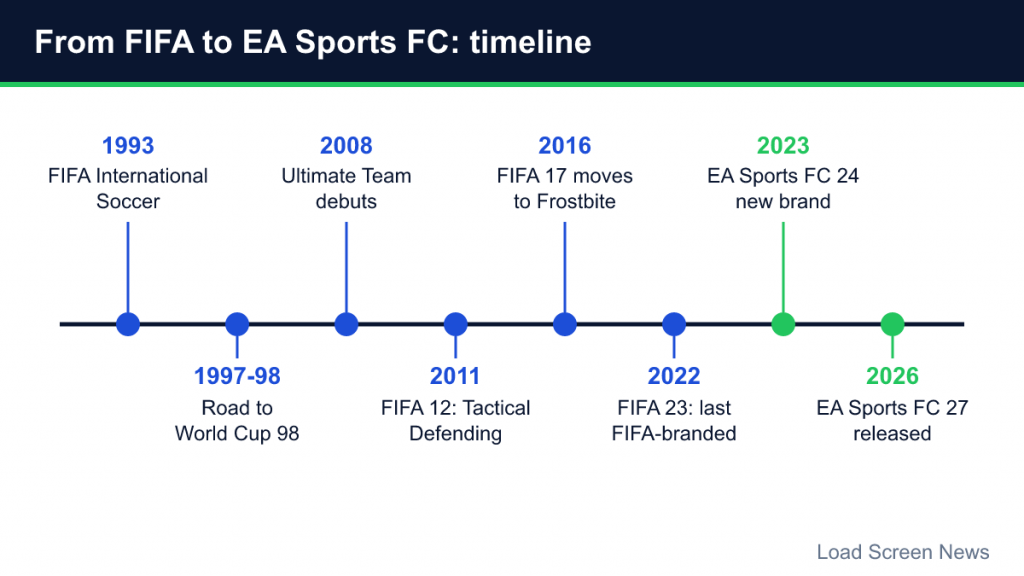
- 1993: FIFA International Soccer launches on Mega Drive.
- 1997–98: Road to World Cup 98 marks the series’ rise.
- 2008: Ultimate Team debuts as DLC for FIFA 09.
- 2011: FIFA 12 introduces Tactical Defending and sets a sales record.
- 2016: FIFA 17 moves to Frostbite and adds The Journey.
- 2022: EA and FIFA announce their split; FIFA 23 is the last FIFA-branded EA game.
- 2023: EA Sports FC 24 launches the new brand.
- 2026: EA Sports FC 27 is released in September.
From an isometric Mega Drive game to a multi-platform franchise, EA’s football series has reinvented itself many times. The 2023 rebrand was the most visible change, but beneath the new name, it remains the same long-running series that has defined football gaming for a generation.