EA Sports FC for Beginners: Controls, Game Modes and First Steps
New to EA Sports FC? Learn the core passing, shooting and defending controls, how FC IQ tactics work, and which modes to try first in EA Sports FC 27.
EA Sports FC is the most played football game in the world, and also one of the most intimidating to start. The controls have layers, the menus are crowded, and online opponents can feel impossibly sharp. The good news is that the fundamentals are simple, and once they click, everything else is refinement.
This guide covers the essential controls, the main defensive concepts, tactics, and an overview of the modes in EA Sports FC 27, which released worldwide on September 25, 2026. Button references use the default Classic layout on PlayStation, with Xbox equivalents in the same positions (Cross is A, Circle is B, Square is X, Triangle is Y). If you want context on how EA Sports FC fits among other sports series, our beginner’s guide to sports video games is a good starting point.
Before Your First Match: Settings Worth Checking
Spend five minutes in the settings menu before you play. A few choices make a big difference for beginners:
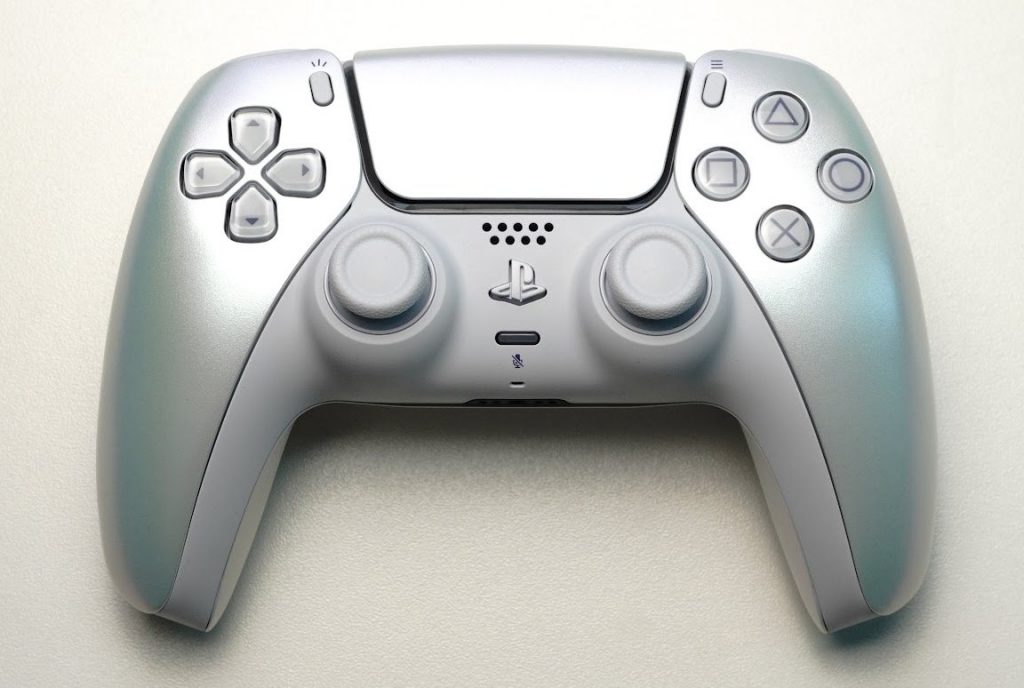
- Controller configuration. The Classic layout is the default and the one most guides refer to. Stick with it unless you have a strong reason to switch, because tutorials and community advice almost always assume it.
- Difficulty. Start low. Amateur or Semi-Pro levels give you time on the ball to learn passing angles. Move up when you win comfortably.
- Assists. Passing and shooting assistance help aim your inputs. Keep them on while learning.
- Camera. A wider camera shows more of the pitch and makes passing decisions easier.
- Gameplay sliders. EA Sports FC 27 expanded its gameplay sliders for offline play, letting you adjust things such as pace and error rates if you want a slower, more readable game.
Recent editions also use gameplay presets. EA Sports FC 26 introduced a Competitive preset designed for Ultimate Team and Clubs, with faster play, and an Authentic preset designed for Career Mode, with more realistic behavior. Online matches use the competitive settings.
Passing: The Foundation of Everything
Passing is the skill that separates frustrated beginners from confident players. Learn these four first:
| Pass | Input (PlayStation, Classic) | When to use it |
|---|---|---|
| Ground pass | Cross | Short, safe passes to nearby teammates |
| Lob pass / cross | Square | Switching play over defenders, crossing from wide areas |
| Through pass | Triangle | Played into space ahead of a running teammate |
| Lobbed through pass | L1 + Triangle | Over a high defensive line |
Hold the button longer for more power. The most common beginner mistake is overpowering short passes, so tap lightly for nearby teammates. Aim with the left stick: the game picks the receiver closest to the direction you point, so look before you pass.
Patience matters more than flair. Passing backwards or sideways to keep the ball is perfectly valid. When the defense shifts, the forward pass opens up.
Shooting: Power, Placement and Shot Types
The basic shot is Circle. Hold to build power, but remember that too much power sends shots over the bar, especially from close range. Inside the penalty area, a shorter press is usually better.
- Finesse shot (R1 + Circle): a curled shot that trades power for accuracy. Ideal from the edge of the box toward the far corner.
- Chip shot (L1 + Circle): lifts the ball over an advancing goalkeeper.
- Low driven shot: pressing Circle a second time after powering up keeps the shot low, which is useful against goalkeepers who are set.
Shot quality depends on more than the button. The shooter’s body position, balance, the angle and the player’s attributes all matter. A weak-foot shot on the run from a tight angle is unlikely to score, no matter how well you time it. Look for clear sight of goal and a player on their stronger foot.
Movement, Sprinting and Shielding
Hold R2 to sprint, but use it selectively. Sprinting makes close control harder and drains stamina, which affects players later in the match. Many experienced players dribble without sprint in tight areas and only sprint into open space.
Holding L2 while in possession lets your player shield the ball, using their body to keep a defender away. Shielding is one of the most underused beginner tools: when you receive the ball under pressure, shielding buys time for teammates to move. The right stick performs skill moves, but basic dribbling and shielding will win you far more possessions than tricks at first.
Defending: Jockey, Contain and Patience
Defending in EA Sports FC is manual by design. You are not rewarded for pressing tackle repeatedly. Instead, good defending is about positioning and timing.
- Jockey (hold L2): your defender faces the attacker and moves sideways, staying between ball and goal without committing.
- Contain (hold Cross): your defender closes in on the ball carrier while keeping some distance.
- Teammate contain (hold R1): calls an AI teammate to pressure the ball carrier. Use it sparingly, because it pulls a player out of position.
- Standing tackle (Circle): press when the ball is away from the attacker’s feet.
- Slide tackle (Square): a last resort. Mistimed slides concede fouls and cards.
The guiding principle is to stay goal-side, jockey, and tackle when the attacker takes a heavy touch. Tactical defending, introduced in FIFA 12, gave equal weight to positioning, intercepting passes and tackling, and that philosophy still shapes the game. EA highlighted enhanced manual defending as one of FC 27’s gameplay changes.
Player switching
Press L1 to switch to the player nearest the ball, or flick the right stick in a direction to choose a specific defender. Learning right-stick switching is one of the most valuable skills you can develop, because it lets you select the player who can actually intercept rather than the one the game thinks is closest.
Tactics and FC IQ
Since EA Sports FC 25, tactics have been built around a system called FC IQ. It has three main parts:
- Player Roles: each position has roles that define off-the-ball behavior, with Focuses that tilt a role toward defense, balance or attack. At FC 25’s launch there were 31 Roles with 52 Role and Focus combinations. Players have familiarity levels with roles, shown as Role+ and Role++.
- Team Tactics: formation, defensive approach (Deep, Balanced, High or Aggressive) and build-up style (Short Passing, Balanced or Counter). You can save custom tactics and share them using codes.
- Smart Tactics: in-match suggestions and quick tactics on the d-pad, such as Team Press, Offside Trap and Get In Box.
For beginners, a sensible approach is to choose a familiar formation, use a balanced defensive approach, and avoid aggressive pressing until you are comfortable. Higher lines and constant pressing leave space behind your defense that you may not yet know how to protect.
The Main Modes in EA Sports FC 27
Kick-Off
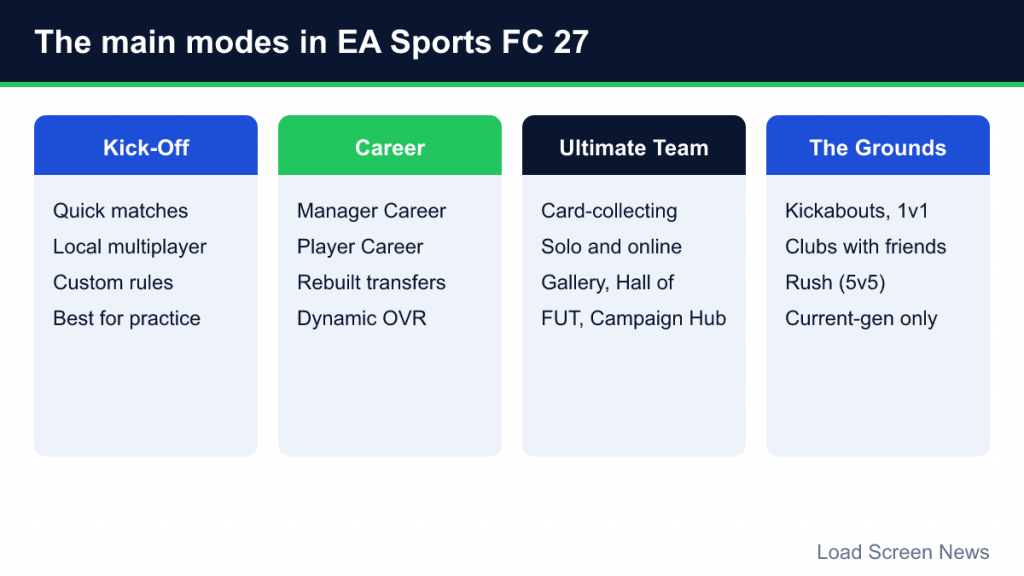
Quick matches with any teams, local multiplayer and custom rules. This is the best place to practice controls.
Manager Career and Player Career
Manager Career puts you in charge of a club: transfers, tactics, training and season objectives. Player Career follows a single player. In FC 27 the transfer market has been rebuilt, and Dynamic OVR means player ratings change during a season based on factors such as form, morale and fitness. Player Career adds rivalries with teammates for a starting spot.
Football Ultimate Team
The card-collecting team mode, with solo and online play. FC 27 adds a Gallery feature, Hall of FUT items and a Campaign Hub for objectives. It includes optional purchases and paid random items; we explain the mode neutrally in our guide to how Ultimate Team modes work.
The Grounds, Clubs and Rush
FC 27 brings its social football together in The Grounds, a hub with Kickabouts, 1v1 matches and Clubs, where friends play together as individual players on one team. Rush, the 5v5 format introduced in FC 25, also features there. The Grounds, including Clubs, is available on PS5, Xbox Series X|S, PC and Nintendo Switch 2, but not on PS4, Xbox One or the original Switch.
A First-Week Plan for New Players
- Days 1–2: skill games and Kick-Off on a low difficulty. Focus only on ground passing and simple shots.
- Days 3–4: practice defending. Play a match where you never press slide tackle and focus on jockeying and switching.
- Day 5: start a Manager Career with a team you know. Learn the tactics screen at your own pace.
- Days 6–7: raise the difficulty one level, or try Rush with friends for a relaxed introduction to online play.
Common Beginner Mistakes
- Sprinting all the time. It reduces control and tires players.
- Overpowered shots and passes. Shorter presses are more accurate in most situations.
- Chasing the ball with one defender. Pulling players out of position opens gaps. Jockey and let the shape do the work.
- Ignoring the weak foot. Shooting from a player’s weaker side greatly reduces accuracy.
- Going online too early. Learn the basics offline first, where mistakes cost nothing.
Quick FAQ
Do I need to learn skill moves straight away?
No. Skill moves are useful later, but passing, shielding and simple changes of direction win far more games for new players. Learn one or two basic moves once the fundamentals feel natural.
Which mode is best for learning?
Kick-Off against the AI on a low difficulty. You can pick any teams, restart instantly and focus on one skill at a time without rewards or rankings at stake.
Why does my team concede so many goals on the counter?
Usually because too many players commit forward, or because you pull defenders out of position by chasing. Try a more balanced defensive approach in your tactics, and jockey instead of tackling early.
Football games reward patience in the same way the real sport does. Keep the ball, move it with purpose, defend as a unit, and the goals will come.