Gran Turismo Series History: From PlayStation to Gran Turismo 7
The history of Gran Turismo from the 1997 PlayStation original through GT3, GT5, GT Sport and GT7, plus Kazunori Yamauchi, license tests and the 2023 film.
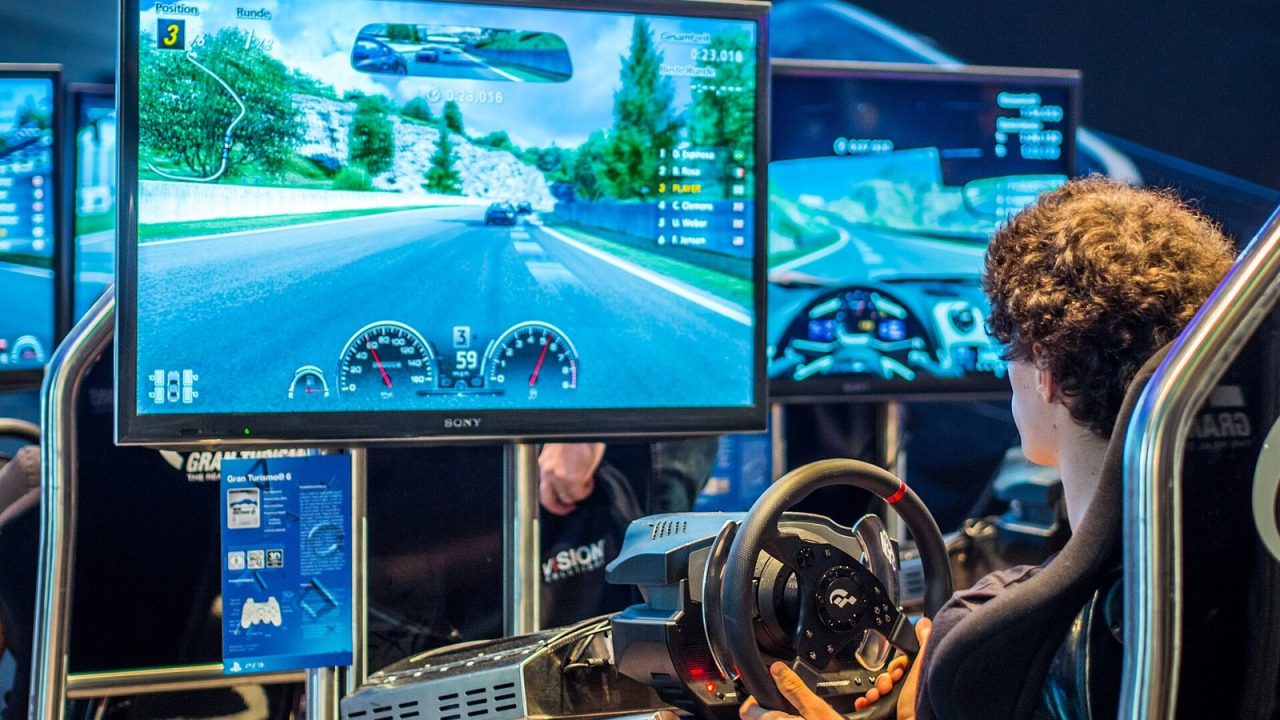
Few racing series have shaped how people think about cars and video games as much as Gran Turismo. Since the late 1990s, Polyphony Digital’s series has combined an encyclopedic love of automobiles with a physics model serious enough to earn the tagline “The Real Driving Simulator.” It became the best-selling franchise in PlayStation history, launched a program that turned gamers into racing drivers, and even inspired a Hollywood film.
This history traces the main games from the 1997 original to Gran Turismo 7, explains the ideas that defined the series, and highlights the milestones along the way. If you are new to the genre, our guide to sim vs. arcade racing games explains where Gran Turismo sits on the spectrum.
Origins: Kazunori Yamauchi’s Five-Year Project
Gran Turismo is inseparable from its creator, Kazunori Yamauchi. He began developing the game in 1992 while at Sony Computer Entertainment Japan, working with a small team then known as Polys Entertainment. Sony was initially unconvinced by his pitch for a realistic racing simulator, and development took around five years.
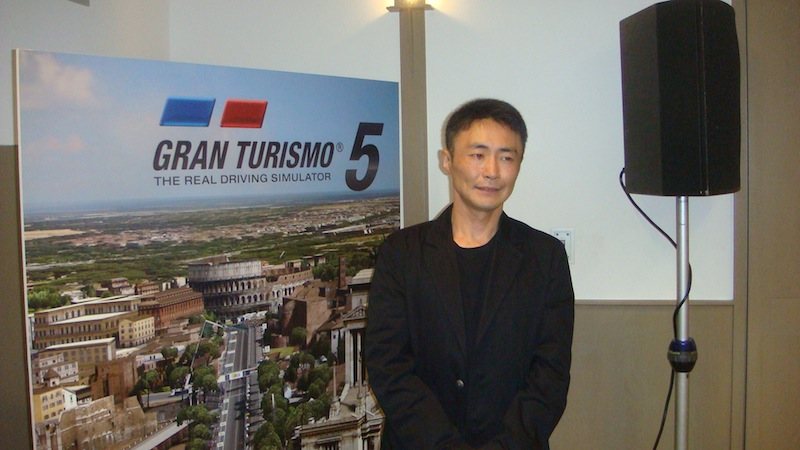
The result, Gran Turismo, launched in Japan on December 23, 1997 for the original PlayStation, followed by North America and Europe in 1998. It featured about 150 licensed cars, more than any simulation of its time, and a structure that combined racing with buying, tuning and collecting cars. It sold about 10.85 million copies and became the highest-selling game on the original PlayStation. Polyphony Digital was established as a studio shortly after its release.
What Made Gran Turismo Different
Racing games before Gran Turismo usually offered a handful of fictional or lightly licensed cars. Gran Turismo treated cars as the stars. Its core ideas became the template for the series and for much of the genre:
- A huge, real car roster from manufacturers around the world, each with its own specifications.
- Simulation-minded physics in which weight, drivetrain and power genuinely changed how cars behaved.
- A career structure, traditionally called GT Mode, where you earned credits, bought cars and upgraded them.
- License tests, short driving challenges that taught skills such as braking and cornering before unlocking new race categories. These tests became a signature of the series and a gentle way to teach real driving technique.
Gran Turismo 2: More of Everything
Gran Turismo 2 arrived in Japan and North America in 1999, with the PAL release in 2000. It expanded the formula dramatically: around 650 cars, rally events and so much content that the game required two discs. It sold about 9.37 million copies, cementing the series as one of PlayStation’s pillars.
The PlayStation 2 Era: GT3 A-Spec and GT4
Gran Turismo 3: A-Spec launched in 2001 on PlayStation 2. Originally announced under the title Gran Turismo 2000, it was a major technical leap, with far more detailed cars and environments. It added endurance races and a “GT Auto” area for car maintenance. With about 14.89 million copies sold, GT3 is the best-selling game in the series.
Gran Turismo 4 followed in 2004 with around 700 cars. It introduced a photo mode, letting players stage and capture images of their cars, and a B-Spec mode in which the player acts as a team director while an AI driver races. GT4 sold about 11.76 million copies.
Handheld and PlayStation 3: GT PSP, GT5 and GT6
In 2009 the series reached handheld hardware with Gran Turismo for PSP, featuring about 800 cars and 35 tracks, each with a reverse layout, but no traditional career mode. It sold about 4.67 million copies.
Gran Turismo 5 had a long and difficult development, delayed repeatedly because of the challenges of the PS3 hardware. When it arrived in 2010, it brought an enormous car list, online racing and features tied to the GT Academy program. It sold about 11.95 million copies, making it the second-best seller in the series.
Gran Turismo 6 came out in 2013 with about 1,200 cars. Unusually, it launched on PS3 after the PS4 had already been released, which limited its audience; it sold about 5.22 million copies.
GT Academy: When Gamers Became Racers
One of the most remarkable chapters in the series’ history took place outside the game. GT Academy, a competition run with Nissan and PlayStation, used Gran Turismo to find skilled players and put them through real-world driver training. Some graduates went on to genuine racing careers. The most famous story, that of Jann Mardenborough, became the basis for the 2023 film Gran Turismo.
GT Academy demonstrated something the series had always claimed: that the skills learned in a serious driving simulator, such as braking points, racing lines and car control, have real value.
Gran Turismo Sport: An Online-First Experiment
Gran Turismo Sport, released in 2017 for PS4, was a departure. It focused on online competition, with structured races and ratings systems, and did not include a traditional single-player GT Mode career. It required an online connection for most features, received free post-launch content, and sold about 12.98 million copies. Its online services ended on January 31, 2024.
GT Sport’s competitive structure, with matchmaking and sportsmanship ratings, influenced the online racing in its successor.
Gran Turismo 7: The Return of the Classic Structure
Gran Turismo 7 released on March 4, 2022 for PlayStation 4 and PlayStation 5. It is the eighth main entry in the series and brought back the single-player GT Simulation Mode, now organized through the GT Café, where “Menu Books” guide players through collecting cars and unlocking content. On PS5 it uses 4K at 60 frames per second with HDR, ray tracing, DualSense haptics and adaptive triggers, and 3D audio.
GT7 drew strong critical reviews for its graphics and driving feel, but player reception was rockier, with criticism focused on microtransactions and the grind required to earn in-game credits. The game also requires an online connection to save progress, with only an Arcade mode available offline.
Polyphony has continued to support the game with major updates:
- PlayStation VR2 support arrived in update 1.29 in February 2023, alongside the first time-limited events featuring the GT Sophy AI.
- Spec II, update 1.40 on November 2, 2023, added four-player split-screen and the snowy Lake Louise circuit.
- By version 1.71 the game listed 574 cars and 41 locations with 121 layouts.
In December 2024 Polyphony also released My First Gran Turismo, a free introduction to the series aimed at players of all ages.
The Gran Turismo Film
Sony Pictures’ Gran Turismo, directed by Neill Blomkamp and released on August 25, 2023, told the story of GT Academy graduate Jann Mardenborough, played by Archie Madekwe, with David Harbour and Orlando Bloom in supporting roles. It is one of the rare films about a video game that focuses on the real people it influenced rather than on the game’s own world.
The Series by the Numbers
| Game | Year | Platform | Reported sales |
|---|---|---|---|
| Gran Turismo | 1997 (JP) | PlayStation | 10.85 million |
| Gran Turismo 2 | 1999 | PlayStation | 9.37 million |
| Gran Turismo 3: A-Spec | 2001 | PlayStation 2 | 14.89 million |
| Gran Turismo 4 | 2004 | PlayStation 2 | 11.76 million |
| Gran Turismo (PSP) | 2009 | PSP | 4.67 million |
| Gran Turismo 5 | 2010 | PlayStation 3 | 11.95 million |
| Gran Turismo 6 | 2013 | PlayStation 3 | 5.22 million |
| Gran Turismo Sport | 2017 | PlayStation 4 | 12.98 million |
| Gran Turismo 7 | 2022 | PS4, PS5 | Not included here |
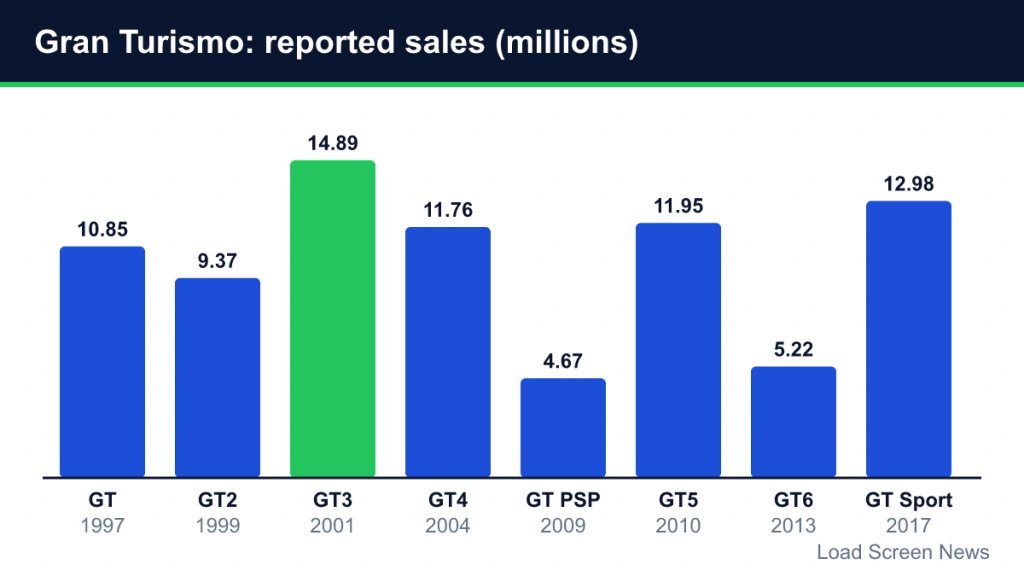
Sales figures are as reported on the series’ Wikipedia page. Across all games, the franchise has sold more than 100 million units, making it the best-selling PlayStation franchise, a milestone reported in 2025.
Ideas That Kept Coming Back
Looking across almost three decades, a few features recur in nearly every main entry and explain why fans stay loyal:
- Licenses as a teaching tool. From the first game onward, license tests turned driving lessons into short challenges. They give new players a structured way to learn braking, cornering and car control before facing full races.
- Collecting and tuning. Buying cars, upgrading them and adapting them to race regulations has been the backbone of the career structure since 1997. GT7’s Café Menu Books are a modern spin on that same collecting loop.
- Photography and car culture. GT4’s photo mode began a tradition of celebrating cars as objects of beauty, which GT7 continues with its extensive photo features.
- Directing rather than driving. GT4’s B-Spec mode let players act as a team director while an AI driver raced, an idea that reflects the series’ interest in the strategic side of motorsport.
Where to Start Today
For new players as of October 2026, Gran Turismo 7 is the natural entry point, since it is the current main game and receives ongoing support on PS4 and PS5. Its Café structure walks you through car history step by step, and assist presets make it approachable on a controller. My First Gran Turismo is a lighter, free introduction for younger or casual players. Older entries are best enjoyed as history: they show how far the series has come, but online services for older entries, including GT Sport, have been switched off.
The Legacy of Gran Turismo
Gran Turismo’s influence reaches well beyond its own sales. It showed that a racing game could be a car encyclopedia, a driving school and a collector’s hobby at the same time. Its best-known rival, Microsoft’s Forza Motorsport, arrived on the original Xbox in 2005 and has been compared with it ever since. Its license tests taught millions of players the basics of braking and cornering, and its assists, from traction control to Active Stability Management, made realistic driving accessible on a controller; our guide to driving assists explains how those work.
Most of all, Gran Turismo has always been a love letter to the automobile. Whether you remember the original PlayStation’s tiny car models or the ray-traced reflections of GT7, the series’ central idea has stayed the same: cars are worth celebrating, and driving them well is worth learning.