How Player Ratings Work in Sports Games
What overall ratings measure, how attributes are weighted by position, and how badges, PlayStyles and potential work in FC, 2K, Madden and The Show.

Every autumn, ratings reveals turn into a small sports event of their own. Fans argue about whether a favorite player deserves one more point, athletes react on social media, and debates about a single number fill comment sections for days. But that headline number, the overall rating, is just the tip of a much larger system. Underneath sit dozens of individual attributes, position-specific formulas, special traits like badges or PlayStyles, and hidden values such as potential. This guide explains how those pieces fit together in EA Sports FC, NBA 2K, Madden NFL and MLB The Show, and why understanding them makes you a better player.
Overall Ratings vs. Attributes
The single most important idea is this: the game mostly simulates attributes, not the overall rating. The overall is a summary, calculated from attributes. When a striker shoots, the game uses his finishing, shot power and composure; when a cornerback covers a receiver, it uses speed, man coverage and awareness. The overall exists to help humans compare players quickly.
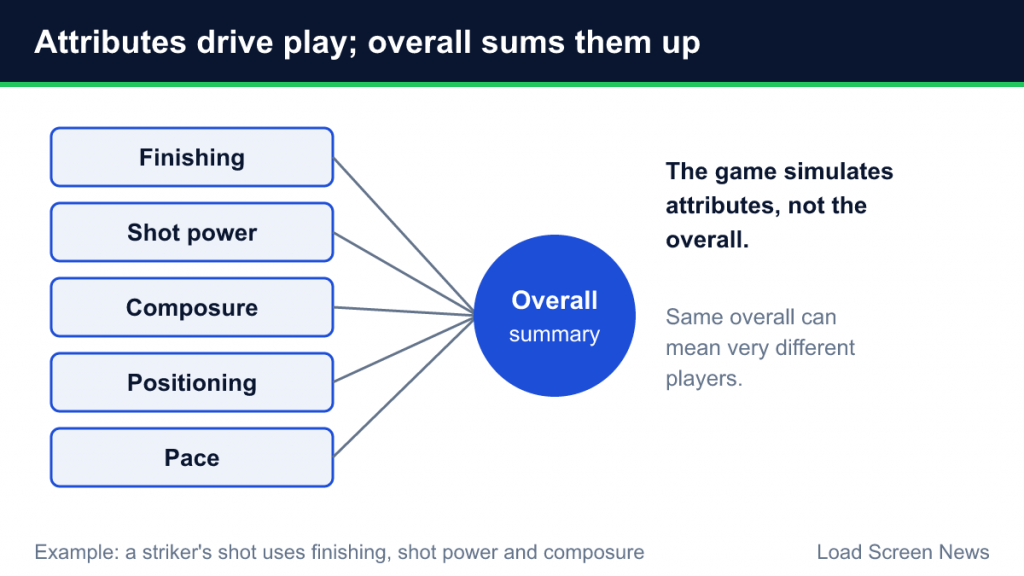
That has practical consequences:
- Two players with the same overall can play very differently. A 78-rated speedster and a 78-rated playmaker are not interchangeable.
- A lower-rated player can outperform a higher-rated one in the right role if his key attributes suit that role.
- Playing someone out of position does not just reduce the overall on paper; it puts the wrong attributes to work.
How Overalls Are Weighted by Position
Overall ratings are usually calculated with position-specific weights. Each relevant attribute is multiplied by a coefficient, and the results are added up. Attributes that matter most for a position get the biggest weights; irrelevant attributes get little or none.
EA’s football series offers a well-documented example. A breakdown published during the FIFA 20 era explained that each position uses its own set of coefficients. For a center-back, defensive awareness carried a weight of 0.15 while jumping carried just 0.04, and the weighted total was then rounded. In that era, a player’s international reputation could also add a small bonus to the final overall for higher-reputation players. Individual details change between editions, but the principle remains: overall is a position-specific weighted average, not a simple mean of all attributes.
This is why a player’s overall can change when he switches positions in-game. The attributes have not changed; the weighting has.
Who Sets the Ratings?
Ratings are produced by dedicated teams at each publisher, often supported by outside data.
EA Sports FC
EA’s football games have long relied on a large network of contributors. Reporting from the FIFA 20 period described a team of in-house producers and around 400 outside data contributors, plus more than 6,000 volunteer Data Reviewers, sometimes called Talent Scouts, who suggest changes to the database. The best reviewers could become paid Data Editors. Notably, reviewers could not change a player’s overall based on one match’s form, a safeguard against overreacting to a single bad game.
Ratings in EA Sports FC 27 also have a new in-mode dynamic: in Career Mode, player overalls can change during a season based on form, morale, fitness, injuries and playing time, a system EA calls Dynamic OVR.
Madden NFL
Madden’s ratings are set by a dedicated ratings team that grades every NFL player across many attributes, then updates them during the season. Ratings reveals before launch have become a marketing event in themselves, including the “99 Club” of players given the maximum overall.
NBA 2K and MLB The Show
Both series maintain their own ratings teams and update player ratings throughout the real-world season. The Show’s attribute set has grown over the years; MLB The Show 26, for instance, added fielder reaction attributes for different directions and a catcher pop time attribute.
The common thread: ratings are a blend of statistics and human judgment. Stats help identify trends, but people decide the final numbers, which is why disagreements are inevitable.
Attribute Categories by Series
Each series groups attributes differently. Here is a simplified overview.
| Series | Typical attribute groups |
|---|---|
| EA Sports FC | Pace, Shooting, Passing, Dribbling, Defending, Physical (each made of several sub-attributes), plus separate goalkeeping attributes |
| NBA 2K | Broad groups such as finishing, shooting, playmaking, defense/rebounding and physicals, closely mirroring its badge disciplines |
| Madden NFL | Physical traits (speed, acceleration, strength), position skills (throwing, catching, blocking, coverage, tackling) and mental traits such as awareness |
| MLB The Show | Hitting (contact and power, often split by pitcher handedness, vision, discipline), pitching (control, velocity, break and per-nine-inning ratings), fielding and baserunning |
The six-category structure in FC is the one most fans recognize because those categories appear on player cards. If you are learning FC, our EA Sports FC beginner’s guide explains how these attributes show up in actual gameplay.
Beyond Numbers: Badges, PlayStyles, Roles and Abilities
Modern sports games add a layer of special traits on top of attributes. These often matter as much as the numbers.
PlayStyles and Roles in EA Sports FC
PlayStyles are traits that boost specific abilities beyond what ratings alone provide. A base PlayStyle improves one area of play; a PlayStyle+ boosts it further. Examples include First Touch, which reduces trapping errors; Press Proven, which helps keep the ball close under pressure; Rapid, which raises top dribbling speed; and Trickster, which unlocks unique flick skill moves.
FC also uses Player Roles as part of its FC IQ tactical system, introduced in FC 25. Each player has familiarity with certain roles. A plus marker (Role+) indicates a player who has mastered a role, and a double plus (Role++) marks a world-class player in that role. Familiarity affects how well a player performs his duties within a tactic.
Badges in NBA 2K
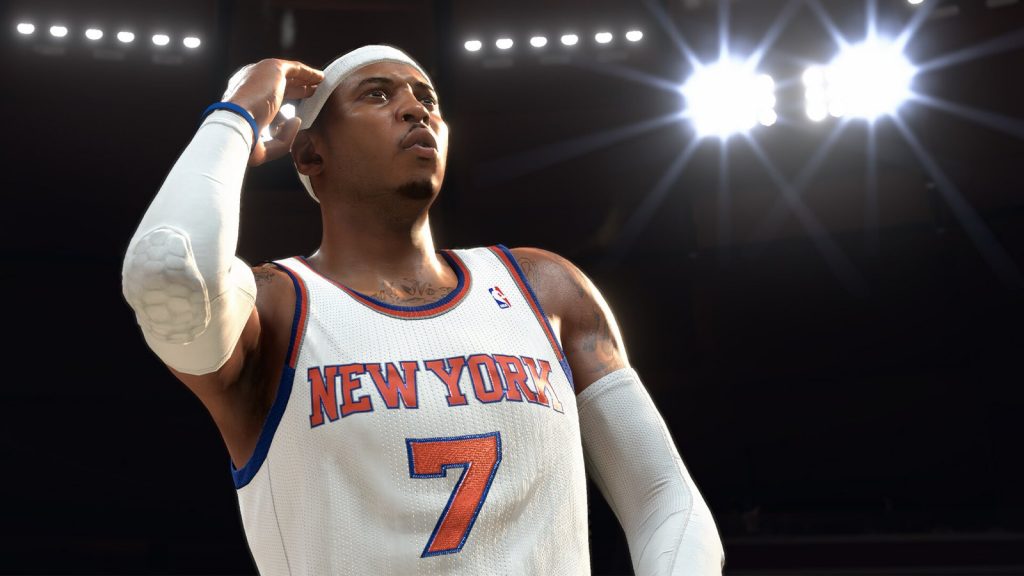
NBA 2K uses badges to give players special abilities in areas such as shooting, finishing, playmaking and defense. Badges come in tiers, with higher tiers giving stronger effects. In NBA 2K27, the game has 53 badges, and its MyPLAYER system adds a new Physicals discipline plus Badge Tokens that determine which badges a created player can equip. Our NBA 2K beginner’s guide covers how this fits into everyday play.
Abilities and X-Factors in Madden
Madden uses Superstar abilities and X-Factor abilities to make elite players stand out. X-Factors, added in Madden NFL 20, are powerful traits reserved for top players, designed to make stars feel bigger in the game. They can swing matchups significantly, which is why the number of X-Factor players on a roster matters when choosing a team.
Quirks in MLB The Show
MLB The Show uses quirks, special traits that reflect a player’s distinctive habits or strengths. Like badges, they add identity beyond raw numbers.
Potential and Player Development
In career and franchise modes, a player’s current rating is only half the story. Many games also track potential: the likely ceiling a young player can reach. Potential may be shown as a range or hidden until scouted, and it is affected by playing time, training and development systems.
Development systems exist across series: Madden uses development traits, NBA 2K’s MyNBA tracks player potential and progression, and The Show’s franchise mode tracks potential for prospects. The key point is that a prospect’s current overall can be misleading. A low-rated teenager with high potential may be far more valuable over a long save than a high-rated veteran.
Ratings in Card-Collecting Modes
In card modes such as Ultimate Team, MyTEAM and Diamond Dynasty, ratings take on another role: they determine card tiers and team strength. Special versions of player items often carry boosted ratings tied to events or real-world performances. That can make the in-game version of a player very different from his base rating. Our neutral explainer on how Ultimate Team modes work covers items, chemistry and spending controls without any buying advice.
How to Use Ratings as a Player
- Look past the overall. Check the attributes that matter for your playstyle and position.
- Match roles to attributes. A fast winger with weak crossing will not suit a role built on crossing.
- Value traits. PlayStyles, badges, abilities and quirks can change how a player performs more than a point or two of overall.
- Think long term in career modes. Potential and development matter more than current overall for young players.
- Expect updates. Ratings change throughout the season, so today’s numbers are not permanent.
Common Misconceptions About Ratings
“Higher overall always wins”
Overall is a summary. In a specific situation, such as a footrace, a contested jump ball or a two-strike count, the relevant attributes decide the outcome. A slower but more aware defender may still be the better choice in a zone-heavy scheme.
“Ratings are pure statistics”
Statistics inform ratings, but human editors make the final call, and some attributes, such as awareness or composure, are inherently judgment-based.
“Ratings never change after launch”
Every major series issues ratings updates during the real-world season, and some modes, like FC 27’s Career Mode with Dynamic OVR, change ratings inside your own save as well.
“Badges and traits are cosmetic”
They are not. Traits such as PlayStyles or badges directly change animations, success rates and available moves, sometimes more than a point or two of overall.
Why Ratings Debates Never End
Ratings will always be controversial because they compress complex, subjective judgments into single numbers. Is a player’s defensive impact captured fairly? Should reputation matter? How much should one great season count against a long career? Each series answers those questions differently, and the answers shift from edition to edition. The best way to approach ratings is to treat them as a useful guide rather than a final verdict, and to remember that in the game itself, the attributes and traits underneath do the real work.