EA Sports FC Formations and Tactics Explained
How formations, team tactics, player roles and quick tactics work in EA Sports FC, plus what 4-3-3, 4-2-3-1, 4-4-2 and 3-5-2 each favor in-game.

In EA Sports FC, the eleven players on the pitch are only partly under your control. At any moment you are guiding one of them; the other ten follow instructions you set before kickoff. That is why tactics matter so much. A good setup puts teammates in the right places to receive passes, cover space and press the ball. A bad one leaves you sprinting back to fix gaps your own formation created. This guide explains how the tactical system works in recent EA Sports FC editions, then looks at four common formations and what each one favors in-game.
The Tactical System: FC IQ
Since EA Sports FC 25, tactics have been built around a system EA calls FC IQ. EA described it as the core tactical and positional system of the game, made up of three main parts:
- Player Roles, which define how each individual player thinks and moves, especially off the ball.
- Team Tactics, which set the overall shape and approach of your team.
- Smart Tactics, which provide in-match suggestions and quick adjustments through the D-pad.
EA says FC IQ’s role familiarity is informed by an AI model trained on real-world data, so players are more comfortable in roles that resemble how they actually play. FC 26 kept building on the same role-based foundation, and the concepts below are the best starting point for the current game, EA Sports FC 27, which launched worldwide on September 25, 2026. Exact role lists and menu labels can shift between editions, so check the in-game tactics screen for the details of your version. If you are new to the series, start with our EA Sports FC beginner’s guide before diving into tactics.
Team Tactics: Formation, Defensive Approach and Build-Up
Team Tactics is where you set the big picture. The key settings are:

- Formation: the base shape of your team.
- Defensive Approach: how high and how aggressively your team defends.
- Build-Up Style: how your team moves the ball forward from the back.
The tactics screen shows your team’s shape both with and without the ball, which is extremely useful. A formation that looks like 4-3-3 on paper might become a 3-2-5 in attack if your fullbacks push forward, or a 4-5-1 in defense if your wingers track back. Looking at both views helps you spot gaps before they cost you goals.
EA also introduced tactical presets, a dynamic summary that analyzes your setup, up to five independent custom tactics and shareable tactic codes. Saving several custom tactics lets you switch between, for example, a balanced default, an all-out attack for when you are chasing a game and a defensive setup for protecting a lead.
Player Roles and Focus
Player Roles are the most important tactical change in modern FC. Each position can be assigned a role, and each role can be modified by a Focus that tweaks one or two characteristics, such as Attack, Defend, Balanced, Roaming, Build-Up or Wide.
When FC IQ launched in FC 25, EA listed 31 roles with 1 to 3 focuses each. Examples by position include:
| Position | Example roles |
|---|---|
| Goalkeeper | Goalkeeper, Sweeper Keeper |
| Fullback | Fullback, Wingback, Falseback, Attacking Wingback |
| Center-back | Defender, Stopper, Ball-Playing Defender |
| Defensive midfield | Holding, Centre-Half, Deep-Lying Playmaker |
| Central midfield | Box-to-Box, Holding, Deep-Lying Playmaker, Playmaker, Half-Winger |
| Attacking midfield | Playmaker, Shadow Striker, Half-Winger |
| Wingers | Winger, Inside Forward, Wide Playmaker |
| Striker | Advanced Forward, Poacher, False 9, Target Forward |
Role familiarity: Role+ and Role++
Players have a familiarity level with each role. A base role means the player can perform it. Role+ indicates mastery, and Role++ marks a world-class performer in that role. Playing someone in a role they are familiar with improves how well they carry out its duties. It is one of the clearest reasons to look beyond overall ratings when picking your lineup; our guide to how player ratings work covers that idea in more depth.
Why roles change everything
Roles determine movement. An Inside Forward cuts inside toward goal, opening the flank for an overlapping fullback. A Winger stays wide to stretch the defense. A False 9 drops deep to link play, pulling center-backs out of position, while a Poacher stays on the shoulder of the last defender. Two teams using identical 4-3-3 formations can play completely differently depending on roles.
Smart Tactics and the D-Pad
During a match, the D-pad gives you quick access to tactical changes without pausing. In FC IQ, this includes your saved custom tactics (My Tactics), Tactical Focus options and Quick Tactics. The game can also suggest changes in real time based on how the match is going.
Practical uses:
- Chasing a goal late: switch to a more attacking custom tactic or focus.
- Protecting a lead: switch to a more defensive setup to drop your line and reduce space behind.
- Struggling against pace: lower your defensive line to reduce through-ball danger.
Learning to change tactics mid-match, rather than only before kickoff, is one of the biggest steps from beginner to intermediate player.
Four Common Formations and What They Favor
4-3-3
Four defenders, three central midfielders and a front three of two wide forwards plus a striker. In-game, 4-3-3 offers natural width and a strong front line for pressing high. It suits teams with quick wingers or inside forwards. The risk is the flanks: if your fullbacks push forward and wingers stay high, the wide areas behind can be exposed on counterattacks. Pairing an attacking fullback on one side with a more defensive one on the other is a common way to balance it.
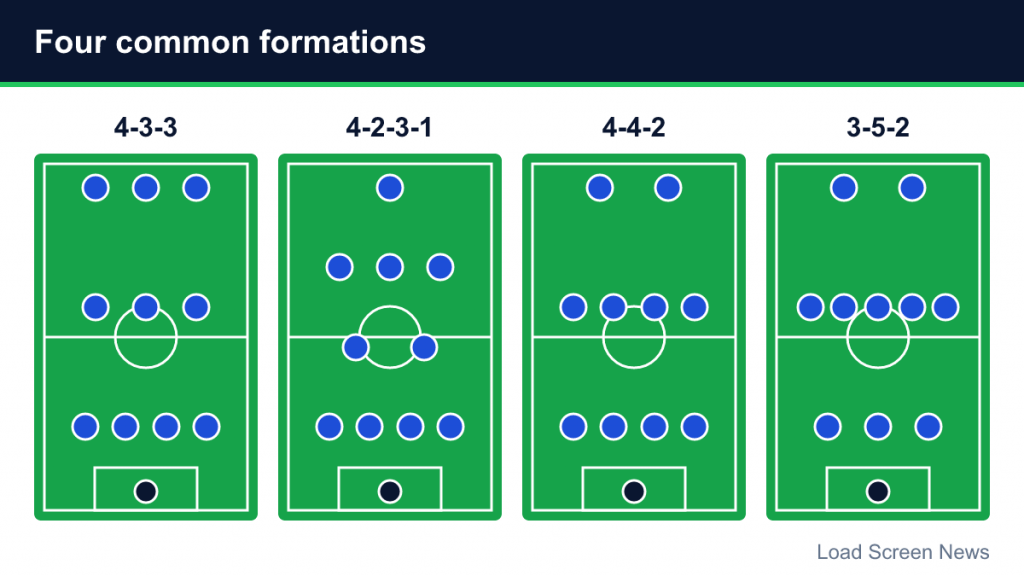
4-2-3-1
Four defenders, two defensive midfielders, three attacking midfielders and a lone striker. It is one of the most balanced shapes in football games. The double pivot protects the back four, while the attacking three provide creativity. It works well for players who like controlled possession and through balls from the central attacking midfielder. The lone striker can become isolated, so a role that links play or makes runs into channels helps.
4-4-2
Two banks of four plus two strikers. It is simple, compact and easy to understand, with two forwards to combine and pressure center-backs. Midfield can be outnumbered against three-man midfields, so wide midfielders often need to tuck in or work hard defensively. It is a good formation for learning positioning because responsibilities are clear.
3-5-2
Three center-backs, five midfielders including two wingbacks, and two strikers. It provides central control and two forwards, with wingbacks providing all of the team’s width. The danger is space behind the wingbacks if they are caught upfield. It suits players who like crossing from wide areas and having numbers in central midfield, but it demands wingbacks with stamina.
Defending With Your Tactics, Not Just Your Thumbs
Many players think of tactics only in attacking terms, but your setup does just as much work without the ball. The height and aggression of your defensive approach decide where the opponent finds space. A high, aggressive approach wins the ball closer to goal but leaves room behind your defense for through balls. A deeper, more patient approach protects that space but invites pressure and long spells without possession.
Roles also matter defensively. A Holding midfielder or Centre-Half stays in front of the back line and screens passes into the striker, while a Box-to-Box midfielder covers more ground but may be caught upfield. Fullbacks set to attacking roles will leave gaps that wide opponents can exploit. When you concede repeatedly from the same area, check which role is supposed to cover it before blaming your manual defending. EA’s FC 27 launch notes emphasized rewarding manual defenders who get into passing lanes, so good positioning from your tactic and good timing from your thumbs work together.
Building a Tactic: A Step-by-Step Approach
- Start with your best players. Choose a formation that gets your strongest players into positions they are rated for.
- Assign familiar roles. Use Role+ and Role++ where possible.
- Balance attack and defense. Avoid giving every player an attacking role or focus. Somebody needs to stay back.
- Check the with-ball and without-ball views. Look for obvious gaps, especially behind fullbacks or in front of center-backs.
- Test in offline matches. Watch where goals come from, both for and against.
- Save variations. Build an attacking and a defensive version of your tactic for in-game switching.
Tactics in Career Mode
Tactics matter even more in Manager Career, where your team’s identity develops over seasons. FC 26 adjusted Career’s Tactical Vision system to be more flexible, with fewer required roles, and renamed the Tiki Taka and Gegenpressing visions to Possession and High Pressing. Building a squad that fits your preferred tactics is part of long-term success in that mode.
Common Tactical Mistakes
- Too many attacking roles. Attacking fullbacks plus attacking midfielders plus forwards who never track back leaves your defense outnumbered.
- Ignoring player familiarity. A world-class playmaker in an unfamiliar role is less effective.
- Never changing during a match. If the opponent is exploiting a weakness, adjust.
- Copying a tactic without understanding it. Shared tactic codes are useful, but you need to know why they work to fix problems.
- A high line without pace. Pressing high with slow center-backs invites through balls.
FAQ
What is the best formation in EA Sports FC?
There is no single best formation. The right one depends on your players, your opponents and your style. Balanced shapes such as 4-2-3-1 are popular because they are forgiving, but many formations can be effective with the right roles.
Do tactics matter in online play?
Yes. Tactics influence positioning for every player you are not controlling, which is most of your team most of the time. For the history of how the series reached this point, see our look at the journey from FIFA to EA Sports FC.