Skill Moves in EA Sports FC: Star Ratings, Inputs and When to Use Them
How skill move star ratings work in EA Sports FC, the main families of moves, when skills help or hurt, and why basic dribbling and shielding come first.

Skill moves are the most eye-catching part of EA Sports FC. A well-timed roulette or heel flick can leave a defender stranded and open the path to goal. They are also one of the most misused tools in the game. Many new players try a skill every time they get the ball and lose possession far more often than they beat anyone. This guide explains how the star rating system works, the main families of skill moves, how inputs are structured in general, and, most importantly, when skills actually help.
How Skill Move Star Ratings Work
Every player in EA Sports FC has a skill moves rating from one to five stars. The rating determines which moves that player can perform. A one-star player has access only to the most basic tricks, while a five-star player can perform the full repertoire.
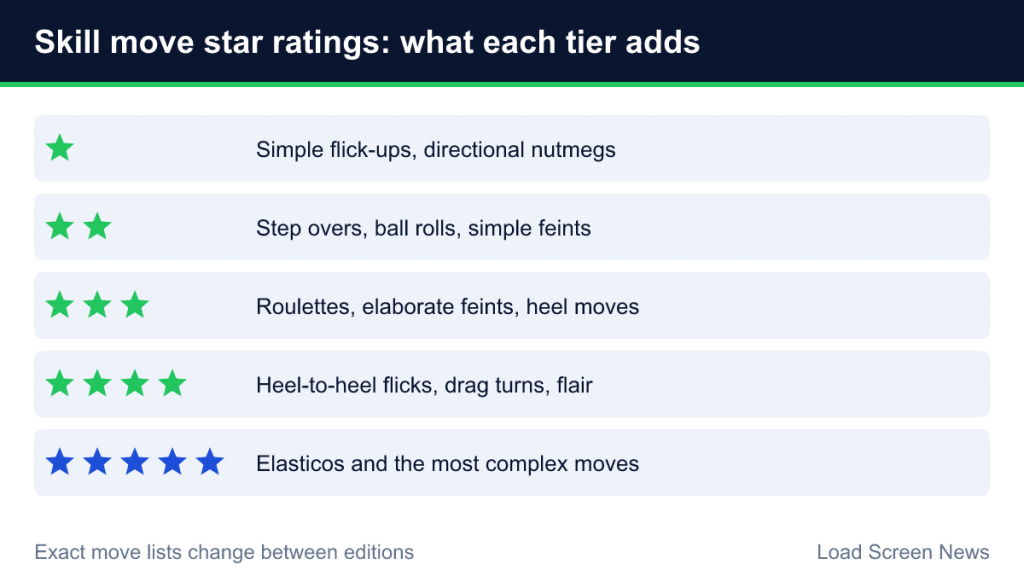
The tiers build on each other:
| Star rating | What it unlocks (general examples) |
|---|---|
| 1 star | Basic tricks such as simple flick-ups, directional nutmegs and first-time feint turns |
| 2 stars | Step overs, ball rolls and simple feints |
| 3 stars | Roulettes and more elaborate feints and heel moves |
| 4 stars | Heel-to-heel flicks, drag turns, flair moves and more advanced combinations |
| 5 stars | Elasticos and the most complex moves in the game |
Exact move lists change between editions as EA adds, removes and reassigns moves. In EA Sports FC 25, for example, EA added moves such as the Big Feint and Stop and Go at two stars and a Toe Drag Stepover at five stars. Third-party guides to EA Sports FC 27, the current edition as of October 2026, list a further batch of new moves across the tiers. Always check the Skill Moves list in the game’s own controls menu for your edition.
Star ratings follow positions in a fairly predictable way. Wingers and attacking midfielders often have four or five stars, while most defenders have lower ratings. That is not just a number on a card; it shapes how your team can attack. Our guide to how player ratings work explains how ratings like this fit into the wider attribute system.
The Main Families of Skill Moves
Instead of memorizing dozens of moves, it is more useful to understand the categories. Most skills fall into one of these families.
Fakes and feints
Moves that suggest you are going one way and then go another, such as step overs and fake shots. A fake shot is one of the simplest and most effective: shaping to shoot or cross makes defenders commit, then you cut the ball away. Feints are especially effective against defenders who are moving toward you.
Turns and spins
Roulettes and spin moves rotate your player around the ball to protect it while changing direction. The roulette is a classic for escaping a defender who is tight on your back or coming from the side. These moves are also useful for turning in midfield when you receive the ball with your back to goal.
Heel flicks and flair moves
Heel-to-heel flicks, flair nutmegs and similar moves change direction or move the ball past a defender quickly. They are high-reward but riskier, best used when you have space to accelerate after the move.
Drag-backs
Drag-backs pull the ball back toward you, letting you stop, change direction or set up a cutback. They are useful near the byline or in the box to wrong-foot defenders who have committed to a slide or a block.
Advanced combinations
Five-star moves such as the elastico combine several touches in one fluid motion. They can be spectacular, but they need space and good timing. Against a well-positioned defender, a simple feint is often more effective.
How Inputs Are Structured
EA Sports FC uses a consistent logic for skill inputs, even though exact combinations vary by move and edition.
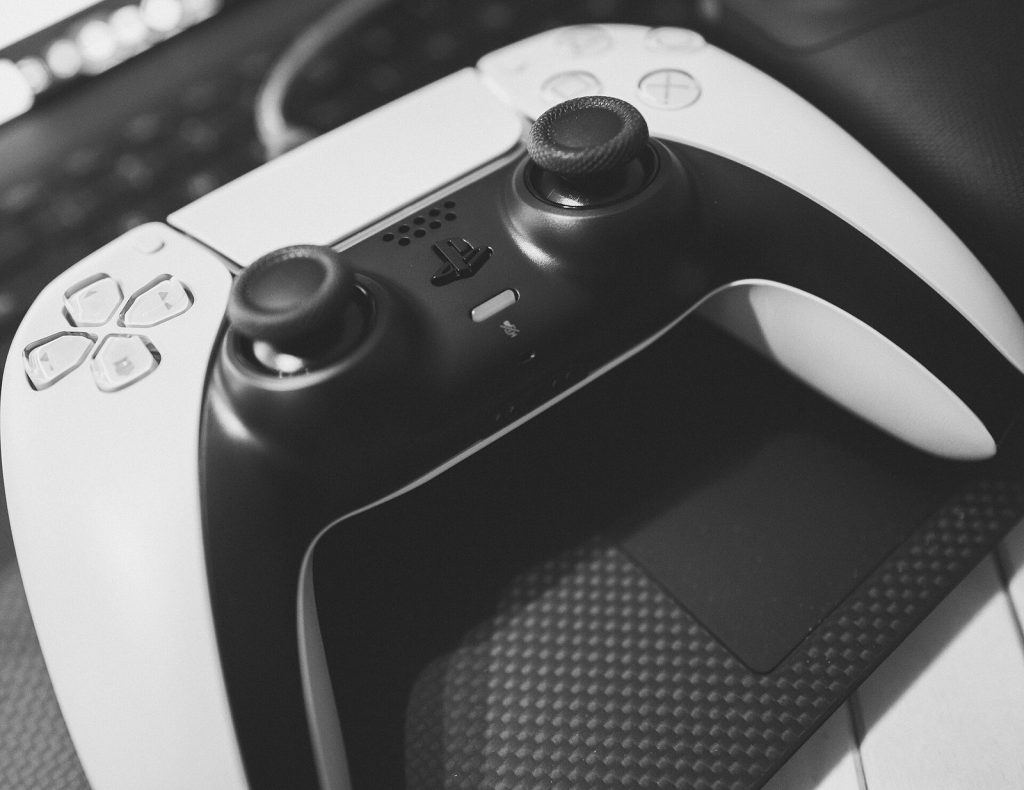
- The right stick does most of the work. Most skills are performed by flicking, rolling or rotating the right stick. A classic step over is a sweep of the right stick around the front of the player; a roulette is a rotation of the right stick toward the direction you want to turn.
- Directions are relative to your player. Right-stick directions are interpreted relative to the direction your player is facing, not the screen.
- Modifiers expand the list. Holding a shoulder button or trigger (for example L1/LB or L2/LT) while using the right stick produces different moves.
- Fake shots use the shot and pass buttons. Pressing shoot, then pass before the shot is taken, combined with a direction on the left stick produces a fake shot.
Because inputs change slightly from year to year, the most reliable approach is to use the in-game Skill Games and Practice Arena to learn a few moves thoroughly. Five moves you can perform reliably are worth more than fifty you half-remember.
Dribbling and Shielding Come First
Skill moves are built on top of basic dribbling, not instead of it. Many experienced players use skills sparingly and rely on fundamentals:
- Close control. Moving slowly with the ball, using small touches, keeps it close and makes it harder to tackle.
- Changes of pace. Slowing down and then accelerating beats defenders more often than many skills.
- Shielding. Using your body to protect the ball, especially with strong players, keeps possession while teammates move into space.
- Controlled sprinting. A controlled sprint keeps the ball closer than a full sprint, at the cost of some speed.
Recent editions have refined these basics. In FC 25, EA improved turning angles, made effort dribbling more responsive and allowed the ball to run on request. Fundamentals evolve every year, but their importance never changes.
How PlayStyles Affect Dribbling and Skills
PlayStyles are traits that boost specific abilities beyond ratings, with a stronger PlayStyle+ version. Several are directly relevant to dribbling and skills:
- Trickster unlocks unique flick skill moves; the PlayStyle+ version adds more ground and flick moves and makes the player more agile when strafe dribbling.
- Technical increases speed in controlled sprint and makes wide turns more precise, with less reliance on skill moves.
- Rapid raises top dribbling sprint speed and reduces mistakes when sprinting or knocking the ball ahead.
- Press Proven keeps the ball close while dribbling at jogging pace and helps shield against stronger opponents.
- First Touch reduces trapping errors and helps players move into dribbling faster.
The Technical PlayStyle is a useful reminder: in EA’s own description, part of its value is reducing reliance on skill moves. Efficient movement often beats tricks.
When Skills Help and When They Hurt
Skills help when:
- You have space to exploit after the move. Beating a defender is only useful if you can accelerate into the space you create.
- The defender is committed. A defender moving toward you or lunging is vulnerable to feints and turns.
- You are isolated one-on-one near the box with no simple pass available.
- You need to buy time for teammates to make runs, for example with a turn that shields the ball.
Skills hurt when:
- A simple pass is available. Passing moves the ball faster than any player can dribble.
- Several defenders are nearby. Beating one opponent only to run into another wastes possession.
- Your player has a low star rating or poor balance. Failed skills often result in a heavy touch.
- You are in your own half. Losing the ball there leads to dangerous counterattacks.
Learning Skill Moves Efficiently
- Pick a small set. Learn one fake, one turn, one drag-back and one fake shot first.
- Practice in Skill Games and the Practice Arena. Repetition builds muscle memory without the pressure of a match.
- Use them in offline matches. Try moves against the CPU before using them online.
- Watch defenders’ movement. Learn to recognize when a defender is committing.
- Add moves gradually. Once your core set is reliable, add a new move each session.
If you are still learning controls in general, our EA Sports FC beginner’s guide covers passing, shooting and defending basics that make skill moves more effective.
Skills and Team Tactics
Skills are more effective when your tactics create one-on-one situations. Wide players with roles that keep them wide, such as a Winger, are more likely to face isolated defenders. Inside forwards cut inside and can use turns and drag-backs to create shooting angles. If your tactics leave your skillful players crowded by defenders, you will see fewer chances for them to use their moves. Our guide to formations and tactics explains how roles create space.
Common Mistakes
- Spamming skills. Constant tricks make you predictable and waste possession.
- Using skills with low-rated players. Many moves are unavailable, and others are less reliable.
- Ignoring the fundamentals. Close control, shielding and changes of pace win more duels than flashy moves.
- Forgetting the end product. A skill only matters if it leads to a pass, a cross or a shot.
Quick FAQ
Can a one-star player still beat defenders?
Yes. Changes of pace, body feints with the left stick, fake shots and simple drag-backs are available to everyone, and good timing makes them effective even without advanced skills.
Are skill moves better offline or online?
The moves are the same, but human opponents read patterns faster than the CPU. Moves that work repeatedly offline may be anticipated online, so variety matters more against people.
Why do my skills fail even with a five-star player?
Usually because of timing or space. Performing a move too close to a defender, at full sprint, or while the ball is not under control often produces a heavy touch.