EA Sports FC Manager Career Guide: Scouting, Youth Academy and Transfers
A deep dive into EA Sports FC Manager Career: board objectives, budgets, scouting, the youth academy, transfers, Dynamic OVR, training and morale.

Manager Career is EA Sports FC’s long-form single-player mode, and for many players it is the heart of the game. You take charge of a club, deal with a board that expects results, buy and sell players, develop young talent and try to build a team that wins for years rather than just a season. It is a mode where decisions compound: a smart signing in your first summer or a teenager you nurture through the academy can define an entire save. This guide explains the main systems as of EA Sports FC 27, which launched on September 25, 2026, and highlights what changed in recent editions.
Getting Started: Choosing Your Club and Setup
Manager Career offers two broad ways to play. The classic approach lets you pick any club and start a full career with your own settings. EA also offers Manager Live, a set of curated and community-made challenges built within Manager Career. Introduced in FC 26, it uses rotating challenges with specific parameters such as start date, team, league settings and objectives like league position or trophies. In FC 27, players can also build and share their own challenges through a web portal.
When you set up a classic career, think about what kind of save you want:
- A big club gives you a strong squad and a large budget but demanding objectives.
- A smaller club offers a slower build, more reliance on scouting and youth, and a satisfying climb.
- A lower-division club is the classic “road to glory” challenge, with very limited resources.
Choices you make during setup, such as starting budget options and difficulty, shape the whole career. If you want to understand how Manager Career compares to other long-term modes, see our franchise modes explainer.
The Board and Its Objectives
Your board sets expectations at the start of each season. Objectives typically cover areas such as league position, cup performance, finances and the development of young players. Meeting them raises your job security; failing them puts you at risk.
FC 26 cleaned up secondary objectives to focus on meaningful decisions, and actions that previously caused an instant sacking can now trigger a formal board warning first. The same edition introduced the Manager Market: managers can be sacked, poached by other clubs or leave voluntarily, and clubs pick replacements based on factors such as quality, job security, tenure, nationality and tactical vision. You can apply for jobs and receive offers based on your performance. In FC 27, EA describes the option to accept offers to manage another club or even an international team.
Practical advice: read your objectives carefully at the start of each season. Some are flexible, while the most important ones, often league position, matter far more for job security.
Budgets: Transfers and Wages
Your club has a transfer budget and a wage budget, and both matter. A big transfer fee is only half the cost; the player’s wages are a continuing commitment.
- Transfer budget covers fees paid to other clubs.
- Wage budget covers the salaries of your entire squad.
- Budget balance. Many versions of the mode allow you to shift money between transfer and wage budgets, which is useful if you want to sign a high-earning free agent or need extra transfer funds.
Selling players raises funds, but think about squad depth before you cash in. A thin squad suffers when injuries and fatigue arrive.
The Transfer Market in FC 27
EA rebuilt the transfer market for FC 27. Key changes include:
- More realistic player valuations, so prices better reflect quality, age and contract.
- Multi-stage negotiations, with a redesigned Transfer Hub.
- Active club bidding, with AI clubs competing more seriously for targets.
- New negotiation options such as performance clauses and buy-back clauses.
Previous editions also added useful flexibility. FC 26, for example, let you loan out players you have just bought in the same window and made AI clubs more aggressive in pursuing players in the final six months of their contracts. That last point matters: players with expiring contracts can be bargains, but your own expiring stars can also attract unwanted interest.
After FC 27’s launch, EA said it was working to help loan-listed and transfer-listed players receive more offers, and looking at how quickly players ask for transfers when they lack playing time. As with any live game, behavior can change through title updates.
Scouting
Scouting is how you find players who are not obvious targets. The usual flow is to hire scouts, send them on assignments with criteria such as position, age and key attributes, and receive reports on players who fit. Higher-quality scouts produce better and more accurate information.
FC 26 improved scout reports to factor in player potential and to link directly to full stats for leagues you simulate. FC 26 also let you simulate up to five additional leagues, which makes the transfer world deeper and gives scouting more to work with.
Tips for better scouting:
- Be specific. Narrow criteria produce more useful reports.
- Look at lesser-known leagues. Talented players are often cheaper outside the biggest competitions.
- Balance current and future value. A player who can start now and develop further is ideal.
The Youth Academy
The youth academy is where long saves are won. You send youth scouts to search for prospects, receive reports on promising teenagers and decide whom to bring into your academy. As players develop, you choose when to promote them to the first team, keep them in the academy or release them.

EA lists the Youth Academy as a core part of squad building in FC 27’s Manager Career. FC 26 added the ability to make substitutions in Youth Tournaments and youth stadiums that reflect club stature.
Youth academy tips:
- Prioritize potential over current rating. A low-rated youngster with a high ceiling is often worth more long-term.
- Give minutes. Young players need playing time to develop. Loans can help when your first team is too strong.
- Do not hoard. Academy spots are limited. Release players who have plateaued.
Player Development, Dynamic OVR and Training
Player development in Manager Career depends on playing time, training and form. In FC 27, EA introduced Dynamic OVR: player overall ratings can change during a season based on form, morale, fitness, injuries and playing time. That means a player in great form can temporarily rise above his base rating, while a player who rarely plays may decline. EA has highlighted that this can even help revive the careers of older stars.
FC 27 also introduced a new Stamina system affecting squad rotation and recovery, which makes depth more important than in older editions. Rotating players to manage fitness is no longer optional on a long season.
Training plans let you balance improvement against fatigue. In FC 26, EA extended training plans to national teams, balancing Sharpness and Energy. The general rule across editions: heavy training improves sharpness but costs energy, so plan around your fixture schedule.
Morale and Squad Management
Player morale affects performance and, in FC 27, feeds directly into Dynamic OVR. Morale is influenced by playing time, team results, contract situations and how you handle interactions such as press conferences and unexpected events. FC 26 added Unexpected Events, random narrative moments involving players, the board and the media, with adjustable frequency.
Keep an eye on your squad’s mood:
- Playing time promises matter. Players who expect to start and do not may become unhappy and request transfers.
- Contract renewals. Renew key players early to avoid losing them cheaply.
- Squad roles. Assign roles such as crucial, important and rotation to set expectations.
Staff and Simulation Depth
Beyond players, your backroom matters. FC 26 added a staff market in which available coaches refresh every two weeks, with an inbox notification when new options appear. It also expanded Live Starting Points to more than 20 leagues, letting you begin a save from a point that reflects the real-world season. Combined with simulated extra leagues and previous-season stats, these features make the world around your club feel more alive, and they give scouts and transfer targets more context.
Tactics in Manager Career
Your tactics shape both match results and squad building. In FC 26, the Tactical Vision system became more flexible, with fewer required roles, and its Tiki Taka and Gegenpressing visions were renamed Possession and High Pressing. Build a squad with players whose roles fit your tactical identity. Our guide to EA Sports FC formations and tactics explains roles and formations in detail.
Manager Career vs. Player Career
EA Sports FC also offers Player Career, where you create and control a single professional. In FC 27, Player Career includes rivalries, where your performance is compared against rival players, and club objectives. If you enjoy controlling one player rather than a whole club, Player Career is the alternative; our guide to career modes in sports games compares it with similar modes in other series.
A Simple First-Season Plan
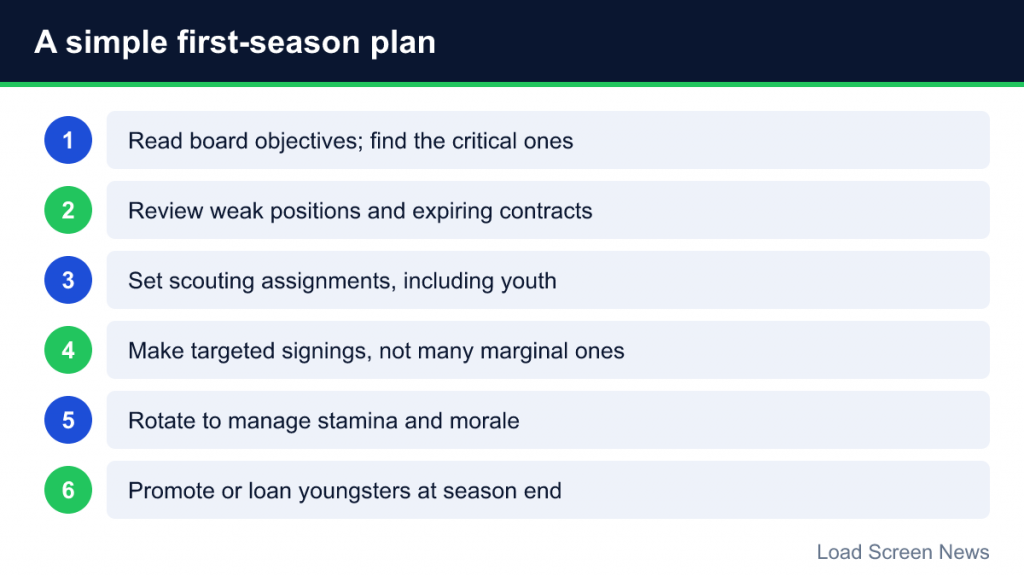
- Read your board objectives and identify the critical ones.
- Review your squad for weak positions and players with expiring contracts.
- Set scouting assignments immediately, including youth scouts.
- Make targeted signings rather than many marginal ones.
- Rotate wisely to manage stamina and keep players happy.
- Promote or loan youngsters at the end of the season based on development.
Common Mistakes
- Spending everything in the first window. Leave room for opportunities and wage increases.
- Ignoring wages. High wages can block future signings.
- Neglecting the academy. Youth development pays off over multiple seasons.
- Not rotating. With stamina and Dynamic OVR, overplaying stars has real costs.
- Forgetting the board. Great signings do not matter if you miss key objectives.